









COOFANDY Shirts Fit Guide: Find Your Perfect Size
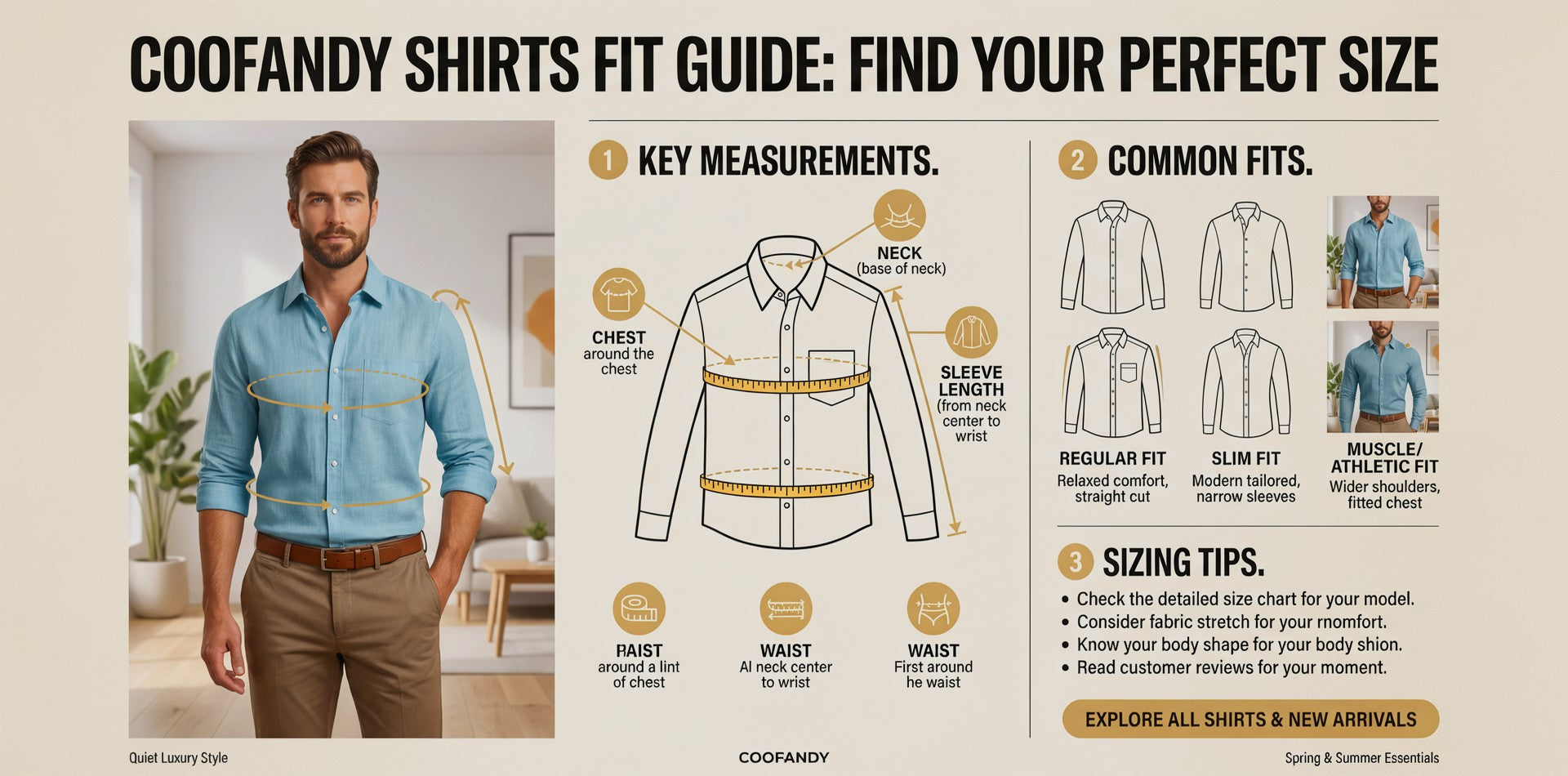
Here's the short answer: COOFANDY shirts generally run true to size, but the right call depends on the fabric, the fit style, and your body proportions. This guide is a sizing decision tool — it tells you exactly how to measure yourself, how to read COOFANDY's size chart, and which size to start with based on your build. No guesswork, no wasted returns.
How to Measure Yourself in 2 Minutes
You need a flexible measuring tape (soft/cloth tape) and a mirror. If you don't have a measuring tape, use a piece of string and measure it against a ruler afterward.
Chest
- Stand naturally with arms relaxed at your sides.
- Wrap the tape around the fullest part of your chest — usually right at nipple level.
- Keep the tape level all the way around your back. Don't puff your chest out or suck in.
- Read the number where the tape overlaps. That's your chest measurement.
Shoulders
- Find the bony point at the top of each shoulder (where the shoulder meets the arm).
- Measure straight across from one bony point to the other, going across the back of your neck.
- This is easiest in a mirror or with a friend — keep the tape flat against your upper back.
Sleeve Length
- Bend one arm slightly (about 90 degrees).
- Measure from the center back of your neck, across the shoulder point, down along the outside of your arm to your wrist bone.
- This gives you a full sleeve measurement. For short-sleeve shirts, measure from the shoulder point to where you want the sleeve to end (typically mid-bicep).
Pro tip: Write these three numbers down and keep them in your phone notes. You'll use them every time you order online.

COOFANDY Size Chart Decoded
Every shirt in the men's shirts collection has a size chart on the product page. Here's how to read those numbers correctly:
"Chest" — What It Actually Means
The "Chest" measurement on COOFANDY's size chart is the garment's full circumference at the chest — not a flat lay measurement. If the chart says "Chest: 42 inches," that means the shirt measures 42 inches all the way around at the widest point.
How to use it: Compare your body chest measurement to the chart. You want approximately 2–4 inches of ease (room) for a standard fit, or 1–2 inches for a slim fit.
"Length" — Where It's Measured
"Length" is measured from the highest point of the shoulder seam (where shoulder meets collar) straight down to the bottom hem. It is not measured from the back of the collar.
How to use it: If you're tall and want to tuck your shirt in, make sure the length gives you at least 3 inches below your belt line. If you wear it untucked, the hem should hit somewhere between mid-fly and the bottom of your fly.
Relaxed Fit vs. Slim Fit — Same Size, Different Room
Here's where most confusion happens. In the same labeled size (e.g., both "L"):
| Measurement | Slim Fit L | Relaxed Fit L | Difference |
|---|---|---|---|
| Chest | ~42" | ~44–46" | +2–4" |
| Shoulder | ~18" | ~18.5–19" | +0.5–1" |
| Length | ~29" | ~30" | +0.5–1" |
These numbers vary by specific style — always check the chart on the individual product page. The point: a relaxed-fit shirt in your usual size will feel roomier, especially through the torso. You do not need to size down for relaxed-fit styles.
Body Type → Size: Quick Match Table
Use this table as a starting point. Your own measurements (from the section above) are always more reliable than body type generalizations — but this gets you in the ballpark fast.
| Your Build | Approx. Measurements | Start With | Notes |
|---|---|---|---|
| 5'8", 150 lbs, lean | Chest 36–38" | M | Slim-fit styles will look fitted; relaxed-fit will drape loosely |
| 5'10", 170 lbs, average | Chest 38–40" | M or L | If chest is over 39", go L for slim-fit styles |
| 6'0", 185 lbs, athletic | Chest 40–42" | L | Check length — if you tuck shirts, verify L gives enough hem |
| 6'2", 200 lbs, tall/broad | Chest 42–44" | L or XL | L if chest is under 43" and you don't mind a standard length; XL if you need more room or length |
| 6'2", 220 lbs, broad chest | Chest 44–46" | XL | XL for most styles; relaxed-fit linen in L may work if chest is 44" flat |
| 5'10", 230 lbs, stocky | Chest 46–48" | XL or 2XL | Use chest as primary guide; waist ease matters more in slim-fit |
| 6'0"+, 250+ lbs | Chest 48–52" | 2XL–3XL | Select styles go up to 4XL or 5XL — check individual product pages |
The decision rule: When your measurements put you between two sizes, go up. A shirt that's slightly roomier looks better than one that pulls across the back or gaps between buttons.
How Fabric Affects Your Size Choice
You don't need a full fabric science lesson. You just need to know how fabric changes your sizing decision:
| Fabric | What It Means for Sizing |
|---|---|
| 100% Linen | No stretch. If you're borderline between sizes, go up one. Linen drapes — extra room looks intentional. |
| Cotton-Linen Blend | Minimal stretch. True to size for most guys. |
| Cotton (woven) | No stretch, holds structure. True to size. |
| Stretch/Knit blend | Built-in give through chest and back. True to size; slim-build guys may size down. |
On linen and wrinkles: Wrinkles don't affect fit — but they can make a too-tight shirt look even more strained. If you're borderline on size, go up; a slightly relaxed fit lets linen drape naturally.
Wash Shrinkage: What to Expect
Shrinkage changes fit. Here's what to plan for with COOFANDY's natural fiber shirts:
| Wash Condition | Expected Shrinkage | What This Means |
|---|---|---|
| Cold water wash + air dry | Approximately 0–1% | Essentially no change — your fit stays the same |
| Cold water wash + low-heat tumble dry | Approximately 1–2% | Barely noticeable; a 30" shirt might lose ¼" |
| Warm/hot water wash + high-heat dry | Approximately 3–5% | A 30" length shirt could lose up to 1.5" — noticeable |
| Hot water + high-heat repeated cycles | Approximately 5–8% over time | Cumulative effect; shirt can shrink a full size equivalent |
The takeaway: Wash cold, dry low or air dry, and your COOFANDY shirt will fit the same after 50 washes. If you accidentally run it hot, expect it to tighten — which is another reason to size up if you're borderline.
Always check the care label on your specific shirt for the most accurate instructions.
Still Not Sure? Here's Your Safety Net
If the fit isn't right, COOFANDY's return and refund policy gives you a clear path to exchange or return.
- U.S. orders ship from a U.S. warehouse — faster delivery, simpler returns.
- Check the policy page for current terms, timelines, and exchange options before ordering.
- If you're between sizes, order the larger one. Worst case: it's slightly roomy and looks relaxed. Best case: it fits perfectly.
You're not locked in. Order with confidence, try it on at home, and exchange if needed.
FAQ
Are COOFANDY shirts true to size?
Yes, for most men and most styles. COOFANDY follows standard U.S. sizing. The size chart measurements on each product page reflect the actual garment dimensions (full circumference, not flat lay). Measure your chest, compare to the chart, and add 2–4 inches of ease for a comfortable standard fit, or 1–2 inches for a slim fit. If your chest measurement exactly matches the chart number with no ease, size up.
What size should I order if I'm 6'2" and 200 lbs?
Start with L for most styles. If your chest measures over 43 inches, or if you prefer extra room for untucked wear, go XL. For relaxed-fit linen or camp collar styles, L gives most 6'2"/200 lb guys the right balance of length and chest room. If you tuck your shirts and need more hem length, XL is the safer call. Always cross-reference with the length measurement on the product size chart — taller builds sometimes need the next size for body length even when chest is fine.
Do COOFANDY shirts shrink after washing?
With cold water and air drying (or low-heat tumble dry), shrinkage is approximately 0–2% — negligible. Hot water plus high-heat drying can cause approximately 3–5% shrinkage, enough to notice in length and chest tightness. Repeated hot cycles can push cumulative shrinkage to 5–8%. Stick to cold water and low heat, and your shirt will hold its size indefinitely.
Do COOFANDY shirts wrinkle easily?
Linen and cotton-linen blends wrinkle — that's the fiber, not a defect. A light steam or iron while slightly damp smooths them out. If wrinkles bother you, look at cotton-blend or stretch-woven styles instead.
What if the size I order doesn't fit?
COOFANDY's return and refund policy covers fit-related returns and exchanges. U.S. orders ship from domestic warehouses, so the return process is straightforward. Check the policy page for current terms before ordering.
Does COOFANDY have shirts for bigger guys?
Yes. Select styles are available up to 4XL or 5XL. Use the chest measurement as your primary sizing guide — not the S/M/L label. Relaxed-fit and linen styles offer more room through the chest and midsection than slim-fit woven options. Filter the men's shirts collection by your size to see what's available in extended sizing.
Find Your Size Now
Browse the full men's shirts collection — every product page includes a size chart with chest, shoulder, and length measurements. Measure yourself using the method above, compare to the chart, pick your size, and order with confidence.

Had a hard time with issuing a return.
Laissez un commentaire