










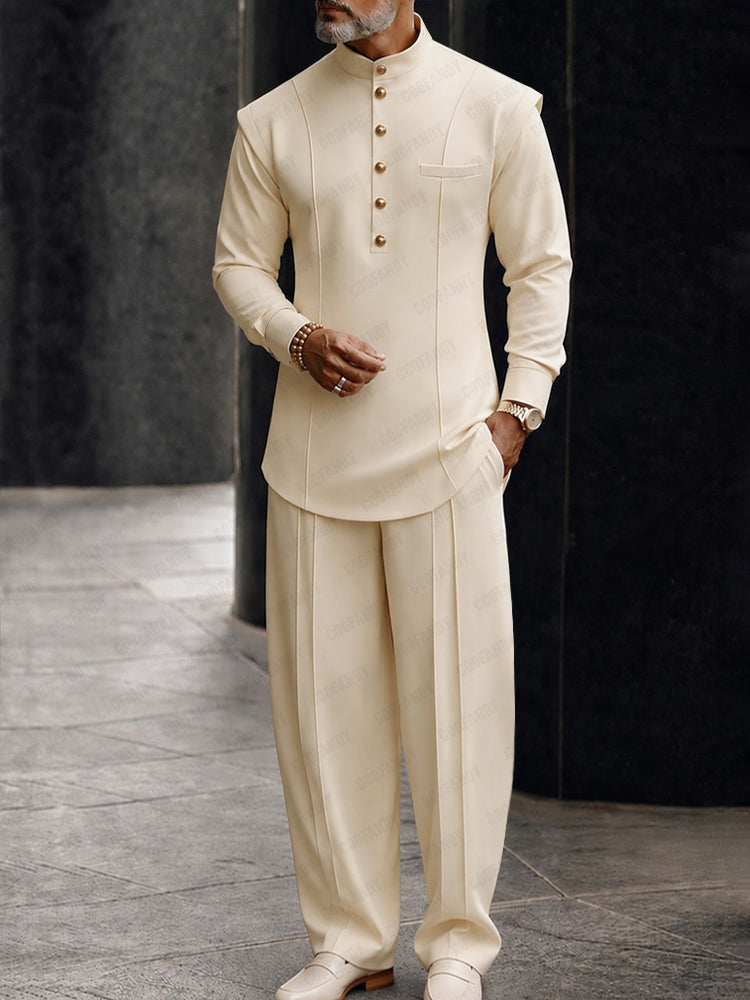

Fall Deals to Black Friday: What to Keep Watching

Keep watching the exact clothing you already want, not every sale banner between fall and Black Friday. Save the selected size and color, record what that purchase would cost on each date, and decide in advance when waiting ends. A useful watchlist tells you what changed since your last check. It does not tell you what next month's price will be.
We recommend keeping the record in a notebook or a note on your phone. Preserve yesterday's observation beside today's. These six steps turn those entries into a decision, with a worked timeline showing which changes deserve a second look.
Choose What Deserves a Place on the Watchlist
Start with two or three garments you have already chosen for a named use. Write something specific, such as "one pair of pants for my weekly office rotation," rather than "fall bargains." If pants are the gap, browse our Men's Pants collection, choose the options that serve that purpose, and then narrow the list. The collection is a starting point for selection, not the thing whose price you are tracking.
Give each entry a maximum delivered spend: the most you are willing to pay for that purchase including the charges shown at checkout. Keep that ceiling independent of any advertised saving. A garment does not earn a larger budget merely because the page presents a larger discount.
Next, set a personal decision date. This is the day you will buy, make another plan, or stop looking, not a prediction of shipping or arrival. If you need clothing for an occasion, leave yourself room to assess the delivery information available when you actually order. A calendar reminder cannot guarantee that an item will reach you in time.
Choose a manageable checking rhythm, perhaps once a week and again on your decision date. You can change that rhythm if your need changes; there is no requirement to monitor every day. Write the next check beside the entry so the watchlist has a purpose between visits. Anything without a use, a ceiling, or a decision point can leave the list before it consumes more attention.
Save the Exact Garment, Not Just Its Name
A product name helps you find a garment, but your record needs to describe the purchase you intend to make. Save its URL, exact selected color and size, quantity, and the seller or checkout you are using. Keep the currency and delivery destination consistent too. These details establish what later rows are being compared with.
For example, the description of our Front-Pleat Design Suit Pants lists pleats, a back elastic waistband and belt loops. Those features help identify the garment before you save your selected size and color. They are not a promise of fit, availability, or a future offer. Check the measurements when selecting a size rather than treating the waistband construction as a fit guarantee.
Put the chosen options in writing even if you save the product link. On your next visit, read the displayed selection before recording a number; do not assume you have returned to the same options. A short label such as "Pants A / chosen color / chosen size / one pair" gives your notes a stable reference without requiring you to remember the page.
If you would genuinely wear a second color, give it its own entry. That lets you compare two acceptable alternatives while preserving the price record for each. Decide that the alternative suits your use before considering its lower number. Otherwise, your watchlist gradually stops describing the garment you wanted and starts describing whichever option looks cheapest that day.
Make Each Price Check a Dated Observation
Add a new row whenever you check. Record the date and, if checking twice in a day, the time. Write the selected item's price, the offer actually applied, the resulting item amount, shipping, tax, and the displayed total. Then label how far you got: product page only, incomplete checkout quote, or complete checkout quote before payment.
Use "unknown" for a charge you have not reached or cannot confirm. Reserve zero for a charge explicitly shown as zero. If shipping is missing, the item amount is not the delivered total. If tax is marked as an estimate, retain that label rather than making the record appear more settled than the screen you saw.
Alongside the numbers, note whether the exact variant was selectable and the relevant offer and return conditions you read. Save the wording or a dated screenshot for a condition you expect to compare later. An offer you saw advertised but did not apply belongs in a note, not in the deduction column. Keep any extra items out of this quote unless they are part of the purchase you originally planned.
Finish each row with one short action: "recheck shipping," "compare with October 8," or "close entry." If you discover a mistake, mark the earlier row corrected and explain why. For instance, if you copied the wrong size's price, label that row invalid for your intended size rather than quietly replacing the number. You can then see why it was excluded when you revisit the log weeks afterward.
Read a Price Log Without Inventing a Bargain
The following log is entirely fictional. The garment, dates, dollar amounts, availability and terms are invented to demonstrate the method; none is COOFANDY price history or a forecast. Imagine one navy pair of Pants A, size M, quantity one, at the same fictional seller and checkout, in USD, for the same delivery destination and shipping method. The shopper sets a $48 delivered-spend ceiling and a November 20 decision date.
Each complete quote below is an observed prepayment checkout total in this fictional example, not a completed order. Shipping and tax in those rows are shown charges, not estimates. The fictional shopper has saved the offer conditions for each applied deduction and meets them on the relevant date. Return conditions remain unchanged across all five checks and are acceptable to this shopper.
| Check date | Selection and availability | Item price; applied deduction; net item amount | Shipping; tax | Total and record status |
|---|---|---|---|---|
| October 8 | Navy M, one; selectable | $46; none; $46 | $5; $3 | $54; complete quote |
| October 22 | Navy M, one; selectable | $44; $4 applied; $40 | $5; $3 | $48; complete quote |
| November 5 | Navy M, one; selectable | $39; none; $39 | Unknown; unknown | Unknown; incomplete quote |
| November 12 | Gray M, one; selectable; navy M unavailable | Gray: $35; none; $35 | Gray: $5; $3 | Gray: $43, complete quote; navy: no quote |
| November 20 | Navy M, one; selectable | $42; $2 applied; $40 | $5; $3 | $48; complete quote |
October 8 establishes a $54 starting observation, above the shopper's ceiling. On October 22, the same purchase has a complete $48 quote: $40 for the item plus $5 shipping and $3 tax. That is $6 less than the October 8 quote, with the identity and conditions held constant. It meets the ceiling. The shopper could reasonably stop then; in this example, they choose to continue until their decision date.
November 5 does not establish a further delivered saving. The $39 item amount is lower, but both charges are unknown. Leave the total unknown and mark the action "complete quote needed." Do not rank that row ahead of the $48 complete quote or fill its empty charges using October's figures.
November 12's gray quote belongs in a separate alternative record. It appears here beside the navy observations to show the difference. The $43 total describes gray, not the intended navy variant, which is unavailable at that check. Keep the navy observation as "unavailable; no complete quote" rather than assigning it gray's price. Nothing in that entry establishes whether navy will become selectable again.
On November 20, the fictional navy selection is selectable at a complete $48 quote. The displayed item price and deduction differ from October 22, but the net item amount and total are identical. There is no additional delivered saving between those two observations. At the decision date, the shopper chooses to buy because the original need remains, the quote meets the ceiling, and the current conditions are acceptable. This closes the log without claiming that $48 is the season's lowest price.

Separate a Changed Purchase from a Changed Price
When the exact size or color is unavailable, preserve the original entry and its last valid quote. Record the new availability observation without inventing a purchasable total. If you want to consider another variant, open a separate entry and assess it on its own merits. You can choose that alternative, but it does not retrospectively lower the cost of the original selection.
A quantity change needs a different response. Suppose the next offer asks you to buy two pairs when your watchlist calls for one. Keep any two-pair quote separate from the one-pair timeline, including its full total. If a second pair has no planned use, leave it out of your intended purchase. A smaller amount per pair does not answer what happened to the price of the single pair you were tracking.
Changed eligibility or return conditions need a note even when the variant stays the same. If a previously applied code no longer applies, retain the old row and record the amount the checkout shows now. Do not carry the earlier deduction into a later observation. If the current offer requires conditions you do not meet, treat its advertised number as outside your comparable quote.
If return conditions change, label the new row "terms changed" and save the relevant wording. Keep the numerical comparison visible, but decide separately whether you accept the new conditions. A lower total with less acceptable terms is a different proposition, not an automatic improvement. This also gives you a practical reason to stop: the purchase may no longer suit you even though its displayed price has fallen.
Give Waiting a Stop Rule
At your decision point, return to the entry's original use and ceiling. If the exact garment still serves that use, is currently selectable, and has a complete quote within your limit under acceptable terms, buying is a reasonable way to close the record. Check the current order details before payment; an earlier observation is not a reserved price or a promise of delivery.
Continue checking only when you still want the purchase, can comfortably wait, and have named the unresolved question. For example, an incomplete quote calls for checking the missing charges. If you extend the watch, set another decision point and write what would close the entry. That gives the extension a concrete purpose instead of moving the finish line whenever another sale appears.
Stop watching when the need disappears, the spending ceiling no longer works for you, or the available purchase has become a compromise you do not want. Write a closing line with the reason and date. "Stopped: no longer needed" is as useful an outcome as an order. Once the entry is closed, later sale messages do not require you to reopen it.
From fall deals to Black Friday, the most useful thing to keep is a clear record of the same intended purchase. Let that record show what you actually observed, and let your own need and spending boundary determine when enough checking is enough.

Frequently Asked Questions
Should I assume clothing will cost less on Black Friday?
No. A calendar date does not establish a future price or available variant. Use your spending ceiling and personal decision date rather than assuming waiting will produce a better offer.
Can I compare a lower price for another color or size?
Yes, as a separate alternative, not as a price drop for the original variant. Keep a distinct record and consider the alternative only if that color and size independently suit your intended use.
Does my watchlist prove the lowest price of the season?
No. It shows the observations you recorded for particular dates, selections and checkouts. It does not cover every intervening price or establish a historical or market-wide low.
About COOFANDY
Founded in 2015, COOFANDY is a menswear brand created for modern men navigating work, weekends, celebrations, and everyday life. Its collection includes shirts, suits, pants, sweaters, and tees designed to help men build versatile, confident looks for different moments and personal styles. Guided by the belief that clothing can reflect confidence and character, COOFANDY focuses on making approachable menswear part of every stage of life.
COOFANDY in the Press
- Is COOFANDY Worth It? The $20 Shirt Test vs. Ralph Lauren, Express and 8 More Menswear Brands
- Best Picks: COOFANDY Shirts & Suits for Commuting, Vacation, and Wedding Season
- From Amazon Basics to 70M+ Customers: The COOFANDY Story Adds a New Chapter with Walmart Distribution
More Reading



Laissez un commentaire