









Smart Casual Shirts for Men: Look Polished Without Overdressing
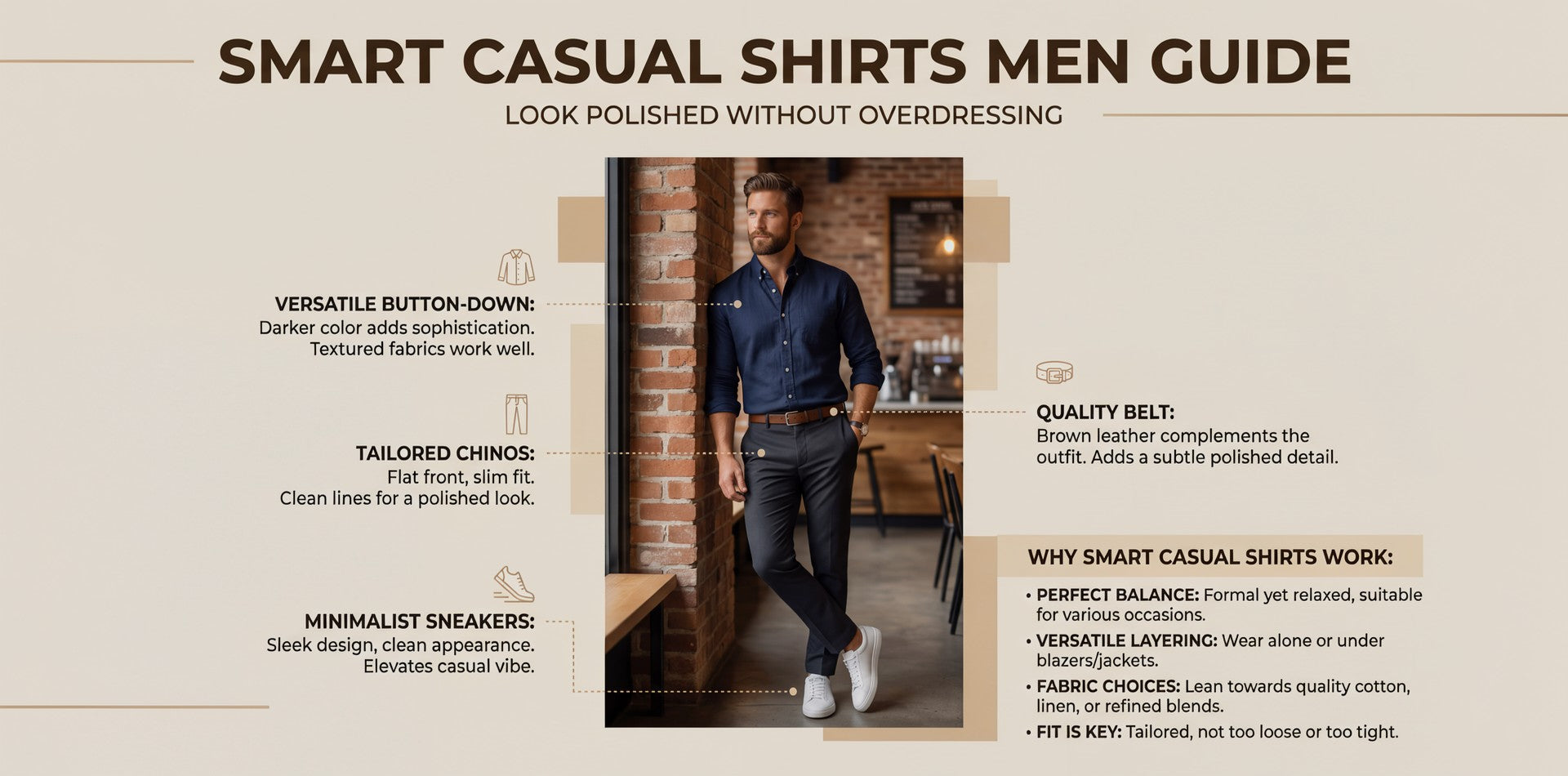
The smart casual shirt that works for most men in most offices: a cotton-linen blend button-down in white, light blue, or sage — collar holds its shape on camera, fabric breathes under AC, and it transitions from a 10am client call to a 7pm dinner without a wardrobe change. Tuck it in for meetings, roll the sleeves for after-work — done.
This guide is about workplace shirt decisions specifically. Not weekend brunch, not vacation packing — just the choices that affect how you're perceived between 9 and 6. Below: a dress code decoder for four types of companies, the science of what looks good on video calls, a commute wrinkle test, and the exact shirt to wear to a startup interview vs. a corporate final round.
Office Fabric Logic: What Actually Works Under Fluorescent Lights
Forget the generic fabric comparison charts. In an office environment, your shirt faces very specific conditions: overhead fluorescent or LED lighting, air conditioning that's usually too cold or occasionally too warm, and long stretches of sitting. Here's what each fabric does under those conditions.
Cotton broadcloth — Looks crisp under office lighting. Holds a pressed finish well for the first few hours, then starts showing seat wrinkles where your back meets the chair. Best for days when you have in-person meetings and can swap it out afterward. Runs cold under aggressive AC.
Oxford cloth — The texture scatters light in a way that hides minor wrinkles. This is why the OCBD is the default office shirt: it forgives a long commute and still looks intentional at 4pm. Slightly warmer than broadcloth, which is a benefit in cold offices.
Cotton-linen blend — Breathes well in warm offices or summer commutes, but shows wrinkles faster when you're sitting for extended periods. The key insight: wrinkles at the elbow and lower back are inevitable after 4+ hours of sitting, but they read differently on linen. On cotton broadcloth, wrinkles look sloppy. On linen-blend, they can read as texture — provided the collar and chest stay clean.
Linen — Similar to cotton-linen but amplified. In a hybrid office, the line between "wrinkled" and "textured" is context. A linen shirt with a clean collar and rolled sleeves reads as intentional, not sloppy. But in a corporate setting with strict standards, pure linen is a risk.
Performance stretch blends — These handle the sitting-all-day problem best. They resist creasing and move with you. The trade-off: under harsh office lighting, some blends develop a subtle sheen that looks more casual than intended. Look for matte-finish performance fabrics if this is your route.
Scene-by-Scene: Workplace Shirt Decisions
The Startup Interview
Startup interviews have their own dress code — but it shifts depending on which round you're in.
First round (phone screen or initial video call):
- A clean, solid-color button-down in white or light blue is sufficient. You're being evaluated on answers, not wardrobe — but looking intentional signals you take the opportunity seriously.
- For video: a structured collar that holds its shape on camera. More on this below.
Second and third rounds (in-person or panel):
- This is where you calibrate to the company's actual culture. Look at their team page, their Instagram, their LinkedIn photos. Match the level of the people one step above the role you're applying for.
- A fitted OCBD or woven cotton shirt, tucked into slim chinos or dark trousers.
- Color: white, light blue, pale grey, or sage. Avoid stark white if the company culture leans creative — it can read as too corporate.
Final round (meeting founders or leadership):
- Slightly more polished than previous rounds. A well-pressed cotton shirt, possibly with a subtle texture or fine stripe. Consider the collar: a wider spread collar photographs as more authoritative than a narrow button-down collar.
- If the company is very casual (hoodies-and-sneakers level), stay at a fitted button-down level but make sure it's pristine.
What never works, at any round:
- A wrinkled shirt, regardless of fabric quality
- A shirt too tight across the shoulders — it reads as trying too hard
- Bold prints unless the company literally sells bold prints
The goal is always the same: look like you already work there, on a slightly better day than usual.
The Hybrid Office: Monday Through Friday
Hybrid doesn't mean one outfit repeated. Each day has its own logic:
Monday (in-office, signaling "I'm here and serious"):
- A pressed Oxford or woven cotton shirt, tucked in. This is your most intentional look of the week. Clean collar, proper fit. You're re-establishing your professional presence after the weekend.
- Pair with tailored trousers or slim chinos and loafers or clean leather shoes.
Wednesday (in-office, midweek rhythm established):
- Slightly more relaxed. A cotton-linen blend or textured shirt. Sleeves can be rolled. Untucked is fine if the hem is straight and designed for it.
- This is where the Casual Cotton Linen Shirt earns its place in the rotation — breathable enough for a commute, structured enough for a 2pm meeting, relaxed enough that you don't feel overdressed eating lunch at your desk.
Thursday/Friday (if in-office — Casual Friday territory):
- A relaxed-fit shirt in a richer color or subtle pattern. Still a collared shirt, but the register drops. Think: untucked, slightly heavier linen, deeper tones like olive, dusty blue, or warm grey.
- The line between "casual Friday" and "weekend" is whether the shirt has a collar and whether it fits properly. That's it.
Video call days from home:
- See the section below on video call specifics. Short version: structured collar, solid color, camera-friendly hue.
After-Work: Office to Social in Two Adjustments
You don't need a costume change. You need one or two modifications:
Adjustment 1 — The collar. If you wore a buttoned-up shirt all day, undoing the top button and (if applicable) removing a collar stay immediately shifts the register from "meeting" to "bar."
Adjustment 2 — The sleeves. Rolling your sleeves to just below the elbow is the single most effective casual-down move. It signals "off the clock" without changing anything else.
What helps the transition work:
- A shirt in a slightly richer or warmer tone (olive, dusty rose, slate blue) transitions better than stark white or pale blue, which always read "office."
- If you wore your shirt tucked, a half-tuck or full untuck changes the silhouette enough.
- Swap leather shoes for clean sneakers if you have them at your desk.
What doesn't work:
- A stiff dress shirt with the tie removed — it looks like you forgot to finish getting dressed
- Keeping everything buttoned and pressed while everyone else is relaxed — context matters

Video Call Shirt Science
Most men don't think about how their shirt looks through a laptop camera. But video calls compress your appearance into a small rectangle where color, pattern, and collar structure matter more than fabric or fit below the chest.
Colors that work on camera:
- Medium blue (not pale, not navy) — universally flattering and provides good contrast against most backgrounds
- Soft white or off-white — clean on camera, but can blow out if your lighting is directly behind you
- Sage, dusty pink, light grey — add visual interest without distracting
Colors that don't work:
- Bright white with strong backlighting — you become a floating head
- Black — absorbs all detail and makes you look like a silhouette
- Fine stripes or small checks — these can create moiré patterns (that shimmering visual artifact) on lower-resolution cameras
Collar structure matters more on video: On camera, your collar is the frame for your face. A collar that holds its shape without a tie (like a button-down collar or a well-constructed spread collar) looks intentional and put-together. A floppy collar that curls or lays flat against your chest reads as unkempt, even if the rest of the shirt is perfect.
Pattern scale:
- Large, simple patterns (wide stripes, block color) read well on camera
- Small, tight patterns (gingham, pin dots) blur into visual noise at low resolution
- Solid colors are always the safest bet for important calls
The Commute Test: Which Fabrics Survive Your Bag
If you commute by train, bike, or subway, your shirt spends time folded or compressed. Here's how common fabrics perform after 45-60 minutes in a bag or backpack:
Cotton broadcloth: Comes out significantly creased. Needs a steamer or iron at the office to look professional. Not ideal for bag commuting.
Oxford cloth: Moderate creasing. The textured weave hides minor wrinkles well. A quick tug and hang at your desk handles most of the damage. This is the most commute-friendly traditional fabric.
Cotton-linen blend: Shows wrinkles, but the linen texture makes them look more like character than neglect. You'll get some looks in a very formal office, but in a hybrid environment, this reads as fine.
Performance stretch cotton: The commute champion. Comes out of a bag looking nearly the same as when it went in. If you regularly stuff your shirt into a bag, this is the most practical fabric choice.
Pure linen: Comes out wrinkled. Full stop. But as noted above, context determines whether "wrinkled linen" reads as sloppy or as "this person chose an interesting fabric." In a creative or casual office: fine. In banking: no.
Practical tip: Roll rather than fold. Rolling creates softer, more distributed creases that fall out faster than hard fold lines.
Dress Code Decoder: Four Company Cultures, Four Shirt Approaches
Nobody hands you a manual when you start a job. Here's what the unwritten rules actually mean:
Startup (Seed to Series B)
The reality: The founders wear hoodies. The sales team wears button-downs. Everyone else is somewhere in between.
Your move: A fitted button-down in a solid color, untucked with a straight hem. Cotton or cotton-linen blend. No one will comment on it — which is exactly the goal. You want to be noticed for your work, not your outfit.
Avoid: Anything that looks like you're trying to be the most dressed-up person in the room. Also avoid ironic T-shirts — you're still at work.
Creative Agency
The reality: More permissive than corporate, but appearance is quietly judged because aesthetics are literally the business.
Your move: More texture, more color, more personality. A linen shirt in olive or a cotton shirt with a subtle camp collar. Patterns are welcome if they're tasteful. This is where a slightly bolder choice actually helps — it signals you understand visual communication.
Avoid: Looking like you didn't think about it at all. The "I just threw something on" look reads as low-effort in a context where everyone else is making deliberate choices.
Corporate (Finance, Legal, Consulting)
The reality: Even "business casual Fridays" have an expected standard. The collar stays buttoned, the shirt stays tucked, and anything wrinkled is noticed.
Your move: Pressed cotton broadcloth or fine twill. White, light blue, or pale pink. Structured collar, French cuffs optional. Clean finishing at the cuffs and placket. This is where quality of fabric and construction shows the most, because everything else is uniform.
Avoid: Pure linen in very relaxed fits (the wrinkle factor can read too informal in this context), bold patterns (too loud), anything untucked (too relaxed). A structured cotton-linen blend in a dark neutral can still work if the collar and fit are sharp — it's about how put-together the shirt looks, not the fiber content alone. Performance fabrics are fine if they're visually indistinguishable from cotton.
Remote-First (Occasional Office Days)
The reality: You're in the office once a month, maybe less. Everyone is slightly overdressed because they're unsure of the current norms. The dress code is whatever the Slack channel says plus one level.
Your move: A clean button-down, nicely fitted, in a color that works on video (because that's how people usually see you). On in-person days, match the level of effort you'd bring to an important video call — which should be your standard anyway.
Avoid: Showing up dramatically different from how you present on camera. If people know you from Zoom in blue OCBDs, don't appear in person in a Hawaiian shirt. Consistency matters for trust.
Mistakes That Make Shirts Look Cheap in an Office Setting
Three things that undercut even a well-chosen shirt in a professional environment:
-
Wrong size in the shoulders. The shoulder seam should sit at the edge of your shoulder bone. If it drops below, the shirt looks borrowed. If it rides up onto your neck, it looks too small. This is the one measurement you can't fix with a simple alteration.
-
Collar that won't lie flat. A collar that curls, flops, or refuses to hold its shape makes the entire shirt look disposable — and under office lighting, it's the most visible part of the shirt because it's closest to your face. Check collar stiffness before buying.
-
Visible undershirt neckline. A crew-neck undershirt visible above an unbuttoned collar is the most common mistake in casual office environments. Either wear a V-neck undershirt or go without.
Is COOFANDY Worth It for Office Wear?
Short answer: yes, for most hybrid and smart casual office environments.
The longer answer depends on your specific workplace. For environments that require suits and ties daily, COOFANDY's cotton and woven shirts can serve as the base layer under structured tailoring — they hold up under a blazer and photograph well in formal settings. For the majority of modern offices — tech companies, agencies, startups, consulting firms with relaxed codes, remote-first companies — COOFANDY's button-downs and cotton-linen blend shirts perform especially well as standalone pieces.
What you're getting: shirts that look intentional, feel comfortable through a full workday (including the commute and the post-work plans), and don't require dry cleaning. The cotton-linen blend styles in particular are well-suited to hybrid schedules. The fabric quality has been tested by airmid healthgroup (as noted on COOFANDY's certificates page), meaning materials meet an external standard, not just internal claims.
For most men navigating the uncertainty of modern office dress codes — especially the "smart casual" ambiguity that nobody defines clearly — COOFANDY's range provides a practical starting point. Browse the men's shirts collection to see how styles map across these workplace scenarios.
FAQ
What shirt should I wear to a startup interview? A fitted button-down in a neutral color — white, light blue, or pale grey — is the safest bet for first rounds. For later rounds, calibrate to the company: check their team photos and match one level above the baseline. Cotton or cotton-linen blend in a solid color, tucked into slim chinos or dark trousers. Avoid wrinkles, avoid bold prints, avoid anything that makes you the most formally dressed person in the room.
Are COOFANDY shirts good enough for office wear? For most offices, yes — including hybrid, smart casual, and business casual environments. The shirts are well-constructed, machine washable, and available in styles that work from morning meetings through after-work plans. In more formal settings, COOFANDY's structured cotton and woven shirts work well under a blazer or suit jacket. For the majority of modern American workplaces — which have shifted toward comfort and versatility — they hold up as standalone pieces too.
What makes a shirt look more expensive than it is? Fit is the biggest factor. A well-fitted shirt in a mid-range fabric will consistently outperform an expensive shirt in the wrong size. After fit: collar structure (a collar that holds its shape without a tie reads as quality), fabric texture (woven cotton and linen have a natural depth that reads well under office lighting), and clean finishing at the cuffs and buttons.
Can I wear a linen shirt to the office? Yes, in most smart casual or business casual environments. A cotton-linen blend in a solid color, with a clean collar and proper fit, reads as intentional and professional. Pure linen works in creative or startup offices but may be too relaxed for corporate settings. The natural texture actually adds visual interest under fluorescent lights.
Best shirt for video calls? Medium blue is the universal winner — flattering on most skin tones, provides good contrast against common backgrounds, and doesn't create visual artifacts on camera. Avoid fine patterns (moiré risk), bright white with backlighting (blown-out look), and black (absorbs all detail). A structured collar that holds its shape without a tie frames your face well on camera. Solid colors are always safer than patterns for important calls.
What's COOFANDY's return policy if the fit isn't right? COOFANDY offers a 30-day return window. Full details are on our return and refund policy page — worth checking before you order if you're unsure about sizing.

Laissez un commentaire