







100% Linen vs Linen-Blend Shirts for Men: Breathability, Wrinkles and Care Compared
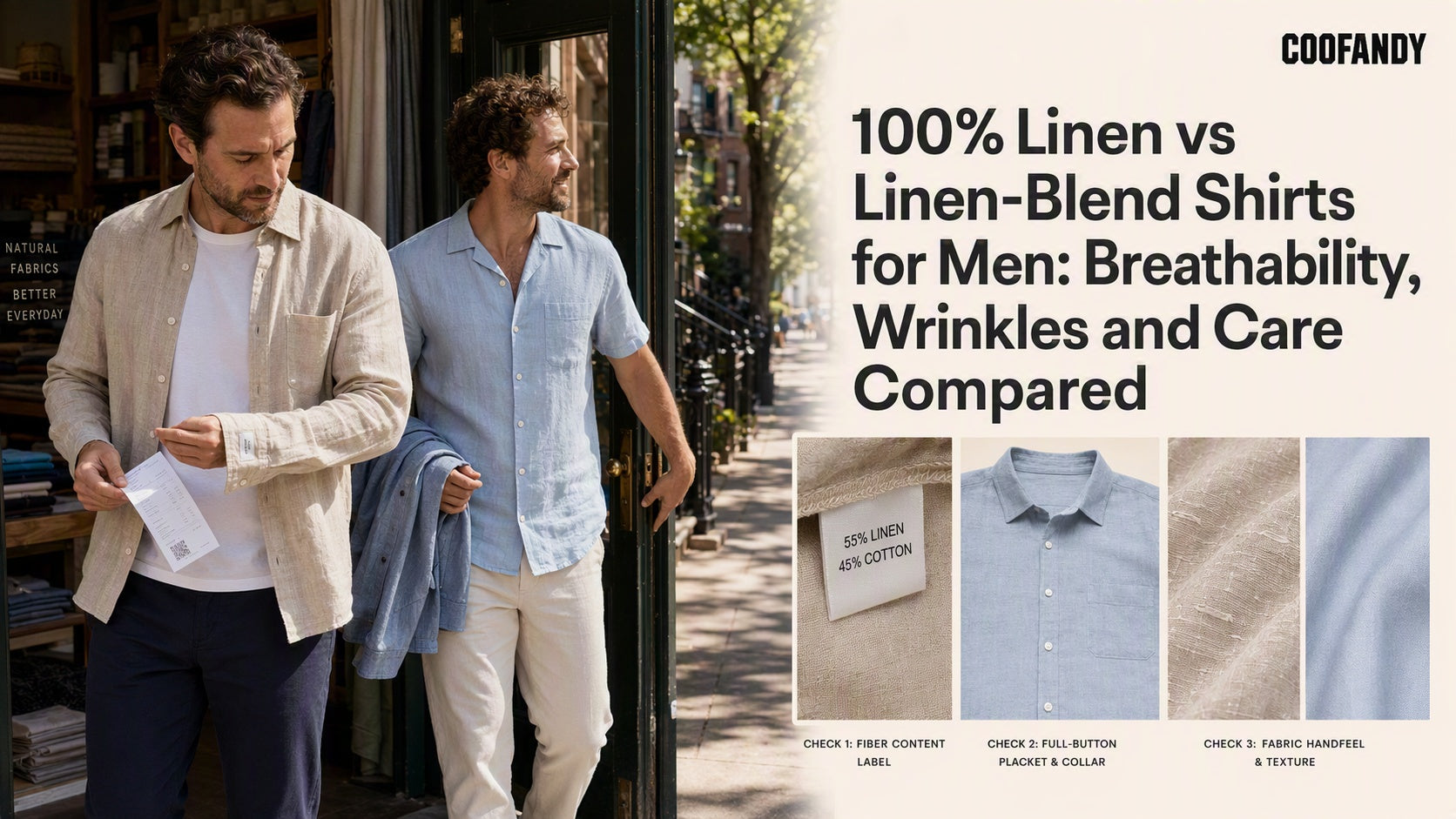
Short answer: Choose 100% linen if linen fiber content is non-negotiable; rule out blends on that basis. Otherwise, choose the specific shirt whose closure, cut, measurements and care routine meet your needs. This guide does not establish a winner for airflow or wrinkle recovery.
A “linen blend” might pair linen with cotton, viscose, polyester or stretch fibers. Those are different compositions, not one fabric. Browse the COOFANDY men's linen shirt collection for cuts and colors, then read the full percentages on each listing.
Four Decisions You Can Make From the Listing
- Pure linen is essential: keep only a listing that states 100% linen; exclude cotton-, viscose- or other fiber blends.
- You want an open overshirt: choose a full-button front and room for the intended underlayer; exclude half-button pullovers.
- Fit comes first: compare the product chart using its stated measuring method. Reject a shirt whose required dimensions are outside the listed options rather than compromising for a preferred fiber.
- Your laundry routine is fixed: keep only shirts whose complete care instructions you can follow. If directions are missing, resolve that before ordering.
Those choices can narrow a shortlist now. Airflow, opacity and wrinkle recovery still require evidence about the finished shirt; they are not a reason to declare every pure-linen shirt or every blend the winner.
What 100% Linen and Linen-Blend Shirts Mean
A 100% linen shirt has linen as its textile fiber content. A linen-blend shirt pairs it with another fiber that changes the feel, drape, stretch, or recovery. It is a tradeoff, not an automatic upgrade.
| Composition | What you may notice | What still needs checking |
|---|---|---|
| 100% linen | Pronounced texture and limited wrinkle recovery | Weave, weight, opacity, care |
| Linen-cotton | A familiar shirting feel; it can still crease | Linen percentage and fabric density |
| Linen-viscose/rayon | Often softer, with more fluid linen drape | Cling, shape retention, care |
| Linen-polyester | May recover shape or dry faster | Airflow, surface feel, fiber ratio |
| Linen with elastane/spandex | May allow more give; confirm stretch and recovery on the finished shirt. | Stretch percentage and recovery |
The product pages show the difference clearly: one COOFANDY long-sleeve shirt is 100% linen, while a short-sleeve style uses 55% linen and 45% cotton. A soft-touch shirt uses 67% viscose, 30% linen, and 3% spandex. These pages confirm composition, not how every shirt with the same ratio will perform.
How to Read a Linen Composition Label
Product names help you browse; the label does the serious work. For covered U.S. products, the FTC's textile-label guidance says generic fiber names and percentages by weight should appear in descending order.

When you read a linen composition label:
- Look for percentages. “Linen blend” should be followed by its composition.
- Read every fiber. A 55% linen/45% cotton shirt differs from a 30% linen/67% viscose/3% spandex shirt.
- Check washing, drying, ironing, and dry-cleaning instructions.
- Treat “pre-shrunk” as product-specific, not a promise of zero change.
- Note stretch fiber. A small amount may ease movement but cannot fix the wrong size.
- Do not confuse “linen-look” with linen. Texture or color does not establish fiber content.
If the listing and sewn-in label disagree, pause before washing or removing tags; use the attached label as the practical reference and ask the seller to explain the difference.
How to Compare the Fabrics Fairly
Two very different shirts can make one fiber look better than it is. An oversized open weave and a close-fitting dense fabric are not competing on composition alone.

Compare a similar fit first; the same size letter may not mean the same dimensions. Choose similar color and weight where you can, and wear both shirts for the same kind of activity. Follow each care label for wash comparisons, using matching settings only when both allow them.
Make a note of five things:
- Airflow while standing, walking, and sitting.
- Dampness or cling after heat and humidity.
- Creases at the elbows, waist, and back.
- Garment measurements before and after washing.
- The shape of the collar, placket, cuffs, and hem after wear.
A home comparison can help you choose between the two shirts you own. It cannot isolate the effect of linen content when the weave, weight or finishing is unknown. Record those differences rather than turning a preference into a rule for every blend.
Breathability and Hot-Weather Comfort
On a hot day, “breathable” needs to mean something: comfort depends on airflow, moisture behavior, and whether damp fabric sticks to the skin.
Neither 100% linen nor a linen blend wins on the label alone. Start with enough room through the chest and back, then compare the finished fabrics in similar conditions. Dense pure linen may feel warmer than a lighter blend; changing the fit can change the experience again.
For a quick check, hold both fabrics against the same light; this shows openness and opacity, not airflow. Then put the shirt on and reach forward, looking for movement room without extra cloth folding against the body.
Check linen shirt breathability with the layers you will wear. If a pale shirt needs an undershirt for coverage, include it in the comparison. You may prefer a denser shirt worn alone to a lighter shirt plus another layer.
Wrinkles and Wrinkle Recovery
Yes, linen wrinkles, but the useful questions are where the folds settle and what the shirt looks like after hanging.

Light rumpling can suit a casual shirt. Deep waist folds or a collapsed collar may bother you more. Linen-cotton is not wrinkle-proof, and adding viscose, polyester or elastane does not establish the recovery of the finished fabric. Judge a wrinkle-resistant linen blend by what happens after wear, not by the phrase alone.
Try a sit-and-hang check. Sit in each shirt for 30 minutes and photograph the elbows, waist and back. Hang it for another 30 minutes, then look again before steaming. These are repeatable comparison intervals, not a standard wrinkle test.
For office days and travel, we would check the collar and placket first, because sleeve creases look normal while a twisting front does not.
Washing, Shrinkage and Shape Retention
There is no honest single percentage for linen shrinkage across every shirt. Blend, weave, finishing, wash temperature, and drying all matter, so one shirt's first wash cannot predict another's.
Before washing, lay the shirt flat and do not stretch the fabric. Record four measurements:
Use the same tape, fastening and measurement points each time. Measure twice if a number looks different. A shift caused by moving the tape is not evidence of shrinkage; check whether the change also affects the fit.
| Measurement | Repeatable method | Before washing (cm) | Fully dry (cm) | Change (cm) |
|---|---|---|---|---|
| Body length | Mark the same high-shoulder point and measure to the same point on the hem | ________ | ________ | ________ |
| Chest width | Button the shirt and measure straight across at one marked level below the armholes | ________ | ________ | ________ |
| Sleeve length | Measure the same shoulder-seam point to the cuff edge, following the product chart if comparing sizes | ________ | ________ | ________ |
| Collar | For a collar designed to close, lay the band flat and measure from the button center to the buttonhole center | ________ | ________ | ________ |
Worksheet notes: record the shirt, size, wash method and drying method alongside your measurements. Change = fully dry minus before washing; a negative value means the measured dimension is smaller. These blank fields are for your own observations, not published test results.
Follow the sewn-in label for washing and drying. The Care Labeling Rule guidance explains why instructions apply to the finished garment. Our linen shirt care guide is a general reference, not a reason to override the directions on your shirt. Let it dry fully before measuring again.
Look beyond the tape measurements. A chest width can stay similar while the placket twists or the hem becomes uneven. Check collar points, cuffs and side seams as well, without using extra heat as a toughness test.
Softness, Drape, Durability and Cost per Wear
Softness and drape are different. Softness is how the surface feels against your skin; drape is how the cloth falls. A viscose-rich blend may fall fluidly without being your preferred texture, so check both instead of treating “soft” as the whole decision.
Check linen drape from the side, because a fluid blend may suit a camp collar but cling at the waist when seated. Fabric with more body can hold a conventional collar and clean tuck, though it may feel less breezy.
For durability, look past the fiber name and check collar edges, cuffs, underarms, buttonholes, seams, and spots rubbed by a bag strap. Strong fabric cannot rescue weak stitching or a fit that pulls at the buttons, and pure linen does not automatically last longer.
Cost per wear = purchase price ÷ realistic number of wears
Treat the number of wears as an estimate, not a durability forecast. For example, a $40 shirt worn 40 times and a $60 shirt worn 60 times both cost $1 per wear. Those are hypothetical prices and wear counts. Laundry cost and care time are separate practical considerations.
Which Fabric Should You Buy?
Start with the annoyance you most want to avoid, then choose a drawback you can live with.
| Your priority | Compare first | Tradeoff to consider | Check on the shirt |
|---|---|---|---|
| Hot or humid weather | Open, light construction in pure linen or a blend | More openness may mean less coverage | Actual layers, torso room and comfort in comparable conditions |
| Easy everyday care | Whichever shirt has a routine you can follow | A convenient wash method does not promise a crease-free result | Washing, drying and ironing directions; shape once dry |
| Frequent travel | A cut comfortable when seated; a blend if its feel appeals | Fluid cloth can cling, and stretch does not prove recovery | Packing folds and label-compliant drying behavior |
| Structured casual office | A collar, placket and hem that stay tidy on you | A more structured shirt may feel different from a loose resort style | Opacity, tuck length and dress code |
| Surface comfort | The actual shirt with seams and a feel you like | “Natural” and “synthetic” do not predict your preference | Inside seams, labels, texture and fit |
For hot weather, compare an open pure-linen shirt with an open blend rather than dismissing either category. If wrinkles are the bigger concern, repeat the sit-and-hang check. Keep those as separate decisions: the shirt you prefer in heat may not have the tidiest finish after sitting.
For a casual office, a stable collar and placket may matter more than smooth sleeves. If the surface or seams bother you, inspect them directly; neither a natural-fiber label nor a softness claim replaces that check.
Choose 100% linen if the fiber content itself is non-negotiable. Choose a specific blend when its listed cut, composition and care routine better match your needs. For options you can compare now, see the seven COOFANDY linen-shirt picks by fabric, closure and budget. This guide does not establish a winner for airflow or wrinkle recovery.
FAQ
Does a linen blend breathe?
It can, although partner fiber, weave, weight, fit, and any undershirt affect the result. A light open blend may feel cooler than dense pure linen, so do not judge by fiber name alone.
Which wrinkles less: 100% linen or a linen blend?
Some blends may recover better, but linen-cotton can still crease. If a tidy look matters, use the sit-and-hang check instead of trusting a wrinkle-resistant claim.
Which is easier to wash?
Choose the shirt with care instructions you can realistically follow. Washing, drying and ironing directions vary, so follow that garment’s label. A blend is not automatically easier to care for.

Leave a comment