










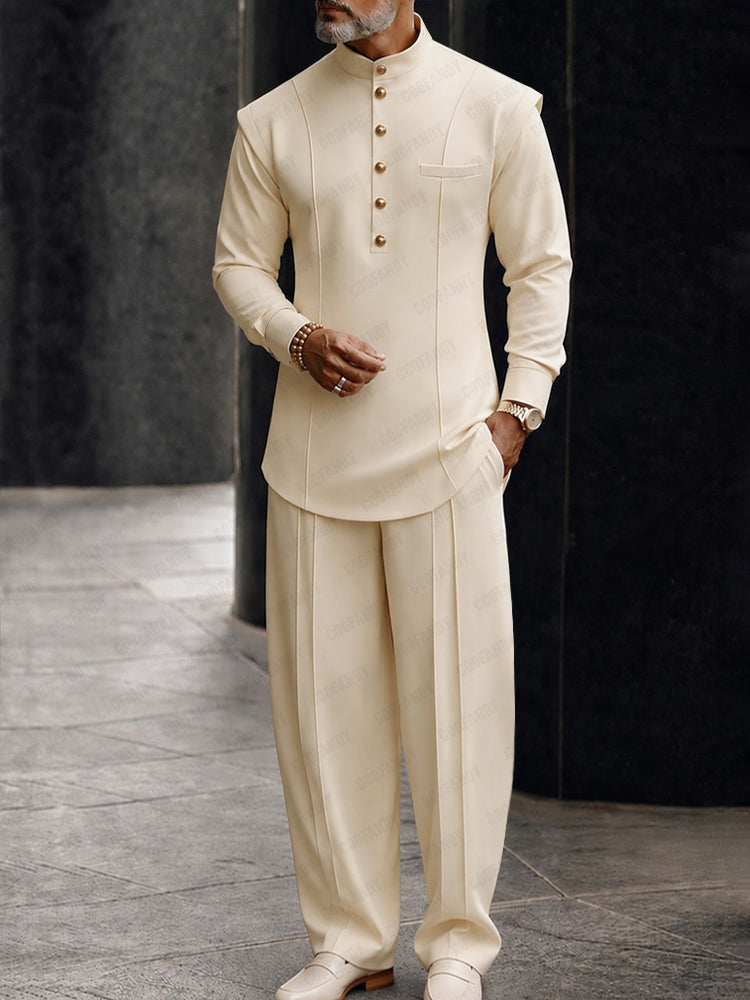
How Should a Wedding Guest Blazer Fit?

A wedding guest blazer should look composed when you stand and let you sit, greet people and move your arms without persistent pulling or discomfort. Check it with the shirt, trousers, shoes and pocket contents you will actually wear. A jacket that works for a mirror photo still needs to work through the ceremony and dinner.
Use the rehearsal below to decide whether to keep the outfit, change one layer, try another size or cut, or ask a tailor for an assessment. First confirm that the invitation permits a blazer with separate trousers; fit does not settle the dress code.
Check the Complete Outfit While Standing
Put on the intended shirt and trousers before the jacket. Fasten the trousers as you will wear them, settle the shirt and look at the outfit with your arms relaxed. Do not stand unusually straight or pull your shoulders back to make a jacket look better.
Check the front open, then close it as the garment is intended to be worn. Use these reference points before testing movement:
| Area | Standing reference | What to investigate |
|---|---|---|
| Collar and lapels | The jacket collar sits close to the shirt collar; the lapels rest against the chest | A persistent gap behind the neck, bunching or lapels pushed outward |
| Chest and fastening | The front closes without dragging the panels together or straining the button | Strong pulling that remains while you stand normally |
| Sleeves | Around the wrist is a common length reference, often with a little shirt cuff visible | Hands hidden by the sleeves, or a cuff arrangement that keeps shifting |
| Overall length | Compare the front and side with the actual trousers and shoes | A torso-to-leg proportion you dislike, even if the button closes comfortably |
These are starting checks, not a demand for one sleeve measurement or silhouette. Compare the jacket's intended shape with the result you want, and turn around to inspect the back as well. Do not dismiss a concern simply because it is outside the camera's front view.
Treat a fold or gap as a prompt to investigate, not a diagnosis from a single crease. Reset the shirt and try again. If the same problem returns while you stand normally, compare another combination. For the wedding, you need an outfit you can wear without constantly adjusting it.
Sit as You Will at Dinner
Use an ordinary dining chair rather than perching on the edge of a sofa. Sit fully, reach toward a place setting and stand again. If you normally open the jacket when seated, rehearse it that way too; an open front should not hide a collar, shoulder or sleeve that still restricts you.
Notice where the discomfort starts. If the waistband is tight even with the blazer off, begin with the trousers. If the shirt pulls across your back without the jacket, try a different shirt. If the problem appears only when the jacket goes on, compare the jacket with a different suitable shirt before changing its size.
Some folds will appear as you sit. The decision is whether you can dine comfortably and whether the outfit settles again when you stand. A photograph of one seated wrinkle is less useful than noticing pressure, repeated tugging or a fastening that pulls every time you return to your feet.
For example, suppose the jacket looks tidy standing but you feel pressure across the upper back when reaching for a glass. Stop and take the jacket off. Repeat the same seated reach in the shirt, then compare an alternative jacket with that shirt if the shirt itself is comfortable. Write down the result as “comfortable standing; restricted seated reach,” rather than deciding that the whole outfit simply needs a larger size.
Keep that note when trying the alternative. If it solves the seated reach but leaves the collar standing away at rest, you have exchanged one problem for another. Bring both observations to a fitting, or choose a combination that passes both parts of the rehearsal.

Try the Movements the Wedding Actually Requires
Rehearse the ordinary movements on the day's schedule. Walk a few steps and use a stair if available. Reach forward for a handshake, make a comfortable greeting gesture and move your arms as you would during a slow dance. Stay within your normal range; you are testing an event outfit, not stretching the garment as far as possible.
Add the items you plan to carry. Put your phone, wallet and other essentials in their intended places, then look at the front and side again. If a pocket bulges or the jacket hangs differently, move the item to a bag or reduce what you carry. An empty-pocket fitting and a loaded wedding outfit are different rehearsals.
Check the outfit with the jacket off, too. If you expect to remove it later, the shirt and trousers should remain a complete combination. Keep the jacket available for any part of the event where the hosts expect it.

Make the Decision While You Still Have Time
Use the result to choose an action rather than repeatedly adjusting the same outfit:
| What you observe | Next step |
|---|---|
| The outfit is comfortable and settles after movement | Keep it; rehearse with the actual shoes and accessories once more |
| A shirt or waistband issue remains with the jacket off | Change that layer first, then repeat the full rehearsal |
| The jacket repeatedly restricts you across combinations | Compare another size or cut rather than forcing the fastening |
| The overall fit works but a particular detail concerns you | Ask a tailor to inspect the actual garment and explain the result you want |
| The event is close and a proposed alteration is uncertain | Choose a complete outfit that already works or confirm a realistic alternative |
If comparing sizes, repeat all the checks. Do not accept new collar, sleeve or balance problems simply because a larger jacket removes one tight spot. Likewise, do not assume a smaller size solves every loose area.
Tell a tailor the event date and bring the intended shirt and trousers. Ask what is feasible, what needs a further fitting and when the garment will be ready. No general checklist can establish which alterations a particular jacket will allow.
Before authorizing work, agree on when you can try the complete outfit again. If that leaves no time to address an unsatisfactory result, have the already-working alternative ready. On the final try-on, repeat dinner, greeting and pocket checks; collecting a garment is not the same as confirming that you can wear it through the wedding.

Use the Same Rehearsal for a Signature Blazer
Our Signature fully lined peak-lapel blazer has an extended peak lapel, a welt chest pocket and two flap pockets. These details help you picture its design; they do not tell you which size will work on your body.
Try it with your chosen wedding shirt, trousers and shoes. Keep the lapels free of competing accessories while checking the overall proportions, then add only the details you plan to wear. Repeat the seated and loaded-pocket checks before deciding the outfit is ready.
Explore the COOFANDY Signature collection and the Signature story when comparing your options. Make the final choice from the complete rehearsal: a blazer that lets you focus on the celebration is more useful than one that needs constant correction.
FAQ
Should I size up a blazer so I can dance in it?
Not automatically. Try normal wedding movements in the complete outfit first. If the jacket restricts you, compare another size or cut and repeat the standing and seated checks. Keep the alternative only if it resolves the issue without introducing other fit problems.
Is a blazer too small if it wrinkles when I sit down?
A seated wrinkle alone is not enough to decide. Check for discomfort, persistent pulling and how the outfit settles when you stand. Repeat the test with the intended shirt and trousers, and ask a tailor to assess a concern you cannot resolve through trying the outfit.



Laissez un commentaire