









What Are Khaki Pants, and Are They the Same as Chinos?
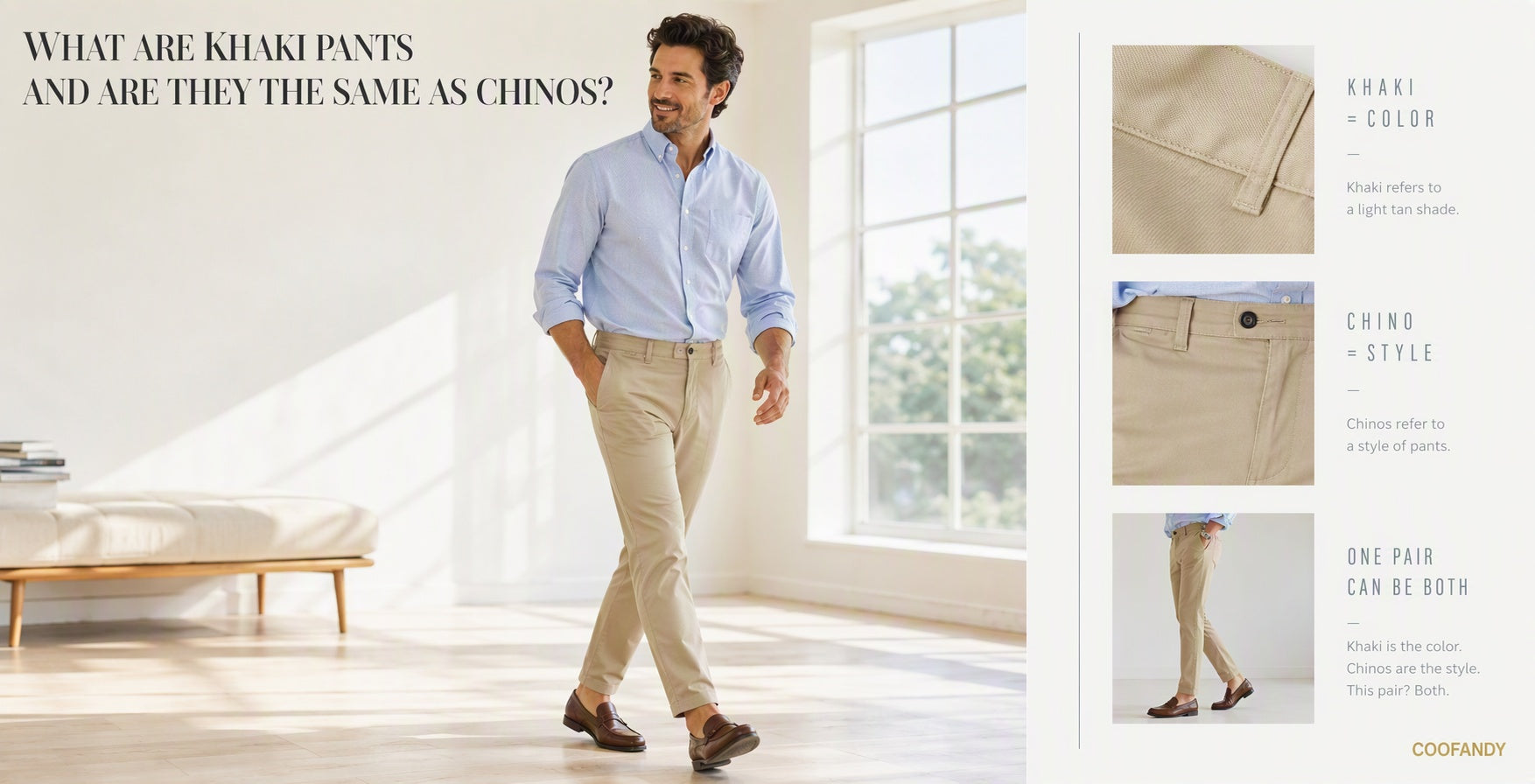
Say you need pants for a workday, dinner afterward, and an errand somewhere in between. You open a chino page, click Khaki in the color menu, and pause. Are these khakis or chinos? Quite possibly both. Khaki may be the color, while chino may be the trouser style. In everyday American English, khakis can also mean the pants themselves. The label gets you started; the fabric, cut, waistband, pockets, measurements, and care instructions tell you what the pants are actually like.
Why “Khaki” Can Mean a Color, Cloth, or Pants
Khaki is a color first. Merriam-Webster defines it as a light yellowish-brown. That sounds straightforward until you start comparing color menus. One seller’s Khaki may look sandy and warm; another may look cooler or a little greener. Tan, stone, sand, beige, olive, and British khaki may sit nearby, but they are not automatic synonyms. Use the name the seller gives that particular color.
The word can also describe cloth, and Americans commonly use khakis for the pants themselves. The overlap has a long history. Merriam-Webster’s word history places British Indian Army use of the term in the mid-19th century. Over time, the color, cloth, and garment became tied to the same word. That explains the vocabulary. It does not give every modern pair the same fiber content, weight, or construction.
Context usually tells you which meaning is in play. In a color menu, Khaki is the seller’s shade name. In a fabric description, “khaki cloth” or “khaki cotton twill” may refer to the material, the color, or both, so read the entire line. In a dress code or an everyday conversation, “khakis” usually means trousers, but that still tells you very little about their cut.
A title that says only “khaki pants” still leaves plenty of blanks. Cotton or a blend? Slim or straight? Belt loops or an elastic waist? Our rule of thumb is to let the label narrow the search, then let the specifications answer the practical questions.
What People Usually Mean by “Chinos”
Chino is more specific, though retailers still give the word some room. Merriam-Webster defines chino as a usually khaki cotton or synthetic-fiber twill, and chinos as clothing made from that fabric. Twill is a weave with diagonal ribs, which may be easy to see up close or barely noticeable. A traditional pair of chinos often has a flat front, slanted hand pockets, a zip fly, belt loops, and rear welt pockets. Those rear pockets look like narrow slits instead of separate pockets sewn onto the outside.
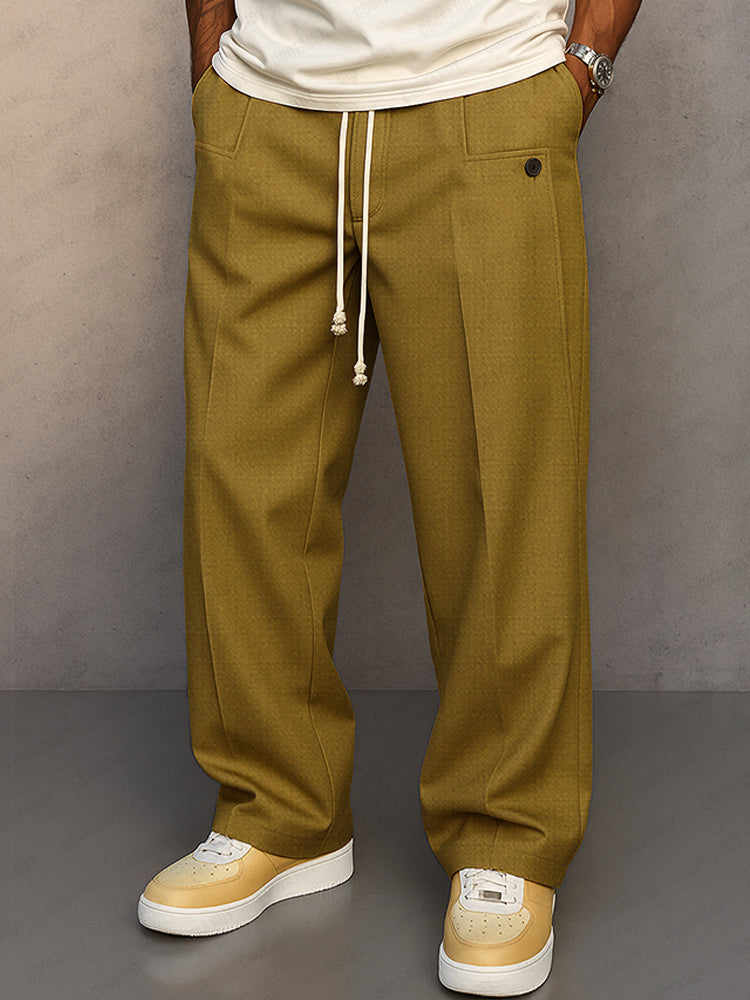
Look through a few current product pages, though, and the old template quickly gets looser. Chinos may use cotton with a stretch fiber or a different blend altogether. Fits range from slim and tapered to straight or relaxed. You will also find pleats, drawstrings, elastic sections, and different pocket layouts.
The label still gives you a useful starting point. It points to a familiar trouser family and, sometimes, to the chino cloth behind it. What it does not promise is a khaki color, 100% cotton, a particular fabric weight, a slim fit, or the right level of formality for your office.
Our reading rule is simple: when Khaki appears under Color, treat it as the shade name. When chino appears in the title or category, treat it as the seller’s style classification. Then read the specifications before making assumptions about fit or fabric.
Khaki Pants vs Chinos: Six Things to Compare
The difference gets easier to use when you break it down this way. Every row describes common retail practice, not a rule that every pair must follow.

| What you are comparing | Khaki pants / khakis | Chinos | What to check on the listing |
|---|---|---|---|
| 1. The name | May name the color, the cloth, or the pants in everyday American English. Common usage, not a fixed definition. |
Usually names the trouser family or the cloth associated with it. Typical usage, not a universal rule. |
See whether the word appears in the title, category, color menu, or fabric line. Its location changes its meaning. |
| 2. Color | Often sits somewhere in the tan or muted earth-tone range, with boundaries that vary by seller. A familiar range, not a color standard. |
Can be sold in khaki, navy, black, gray, olive, white, and other colors. Common options, not a required palette. |
Read the swatch name and the return terms. Screens and lighting can change how a shade looks. Photos are not exact color references. |
| 3. Fabric | May be cotton twill, but khaki alone does not identify the fiber, weave, stretch, or weight. The color name sets no fabric rule. |
Cotton twill and cotton-rich stretch fabrics are familiar choices, although other blends appear. Common construction, not a requirement. |
Look for fiber percentages, weave, stretch, listed fabric weight, and care directions. Specifications matter more than the category name. |
| 4. Fit and cut | May be relaxed, straight, slim, or tapered. Color does not determine silhouette. There is no standard khaki cut. |
Straight and tapered cuts are common, but slim, relaxed, pleated, and drawstring versions also appear. Familiar choices, not limits. |
Compare the rise, thigh room, leg shape, inseam, hem opening, and garment measurements. A fit name is only a starting point. |
| 5. Pockets and construction | A khaki shade tells you nothing about the pockets, pleats, stitching, waistband, or closure. Color does not determine construction. |
Slanted front pockets, rear welt pockets, and restrained exterior stitching are familiar details. Common details, not mandatory ones. |
Count the pockets, then check the fly, waistband, pleats, closures, and visible seams. Details vary from one product to another. |
| 6. Formality | Often falls between casual and business casual, depending on the actual pair. A common use, not a dress-code guarantee. |
Often works in casual or Smart Casual outfits, depending on fabric, finish, fit, and condition. A familiar role, not guaranteed formality. |
Judge the whole pair, then match your shirt, shoes, and outer layer to the setting. The actual dress code still applies. |
In practical terms, Khaki gives you very little information about construction. Chino gives you more, but not enough to choose a pair without reading the product details.
Why One Pair Can Carry Both Labels
A product name has to make sense in search results, on a category page, and inside a color menu. That is how one pair can appear under chinos, offer Khaki as a color, and still be called “khakis” in conversation. From a brand’s point of view, each label helps shoppers find the same pants in a different way.
Chino in the title, Khaki in the color menu
The official COOFANDY Business Casual Stretch Chino Pants (US Only) page listed Khaki among its color options. The specifications gave a fabric content of 97% cotton and 3% spandex, along with a straight leg, flat front, zip fly with button closure, two slanted front pockets, and one rear welt pocket. On this page, chino names the style and Khaki names the swatch.
A chino that does not follow the old template
The official COOFANDY Classic Solid Color Chino Pants (US Only) page also listed a Khaki option. Its specifications gave 70% rayon and 30% polyester, a slim fit, an elastic drawstring waist, a zip fly with button closure, two side hand pockets, and two back pockets. The title still uses chino even though the fabric and waistband differ from the traditional cotton-twill, belt-loop model.
These two pages show how those exact products were labeled on August 3, 2026. Do not treat them as templates for every COOFANDY chino or for the category as a whole.
If a listing still feels contradictory, read it the way we would read any menswear product page, including our own:
- See where each word appears. The title, color menu, and fabric line may be naming different things.
- Read the fiber content, waistband, fly, pockets, and care instructions.
- Check the stated fit and any garment measurements the seller provides. Chino is not a size or silhouette.
- Use photos only for visible details. They cannot confirm an unlisted fiber, fabric weight, hidden construction, or exact color.
Start With Where You’ll Wear Them
Once the terminology is clear, picture an ordinary week. Where will you actually wear the pants? We would start there, because a Tuesday at the office asks for something different from a relaxed Saturday.

For the office
For the office, start with the room you are dressing for. A client meeting usually calls for more polish than a casual Friday. Smooth-looking fabric, a flat front or neat pleats, a straight or gently tapered leg, and pockets that lie flat tend to look more put together. Khaki-colored chinos can work in many business-casual or Smart Casual offices. A formal meeting or conservative workplace may still call for dress trousers.
For weekends
Weekend plans leave more room for comfort and personality. A roomier leg or a drawstring waist can make sense for errands, lunch, or time at home. Softer-looking fabric and larger pockets also pull the outfit in a more casual direction. Those details may feel out of place at work, even when chino appears in the title.
For travel
If you are packing one pair to wear more than once, small details matter quickly. Check the stretch, pocket closures, wash directions, and fabric weight if the seller lists it. An elastic section may provide more give at the waist, but it does not prove wrinkle resistance, quick drying, or longer wear. If the page does not support a performance claim, leave it unknown.
For frequent or demanding wear
For pants you expect to wear hard and often, the color name is the least useful detail. Check any listed fabric weight or density, then look at closures, pocket construction, seam finishing, and stated reinforcement. A khaki shade does not make fabric stronger, and a chino label does not promise workwear durability. If your job requires protective clothing, choose gear made and specified for that purpose.
What to Check Before You Add Them to Cart
Before you hit Add to Cart, give the listing one unhurried read. This order catches most of the details that khaki and chino leave open:
- Notice where khaki and chino appear. One may be the product category while the other is the color.
- Read the official color name and compare it with clothes you already own. Your screen may not show an exact match.
- Check every fiber percentage. Neither label guarantees 100% cotton.
- Look for the weave, stretch, lining, and fabric weight if they are listed. Missing information stays unknown.
- Check the rise and waistband. Look for belt loops, elastic, a drawstring, side adjusters, or a combination of these features.
- Compare the thigh room, leg shape, inseam, hem opening, and garment measurements.
- Count the pockets and note how they close. Check the fly and front fastening too.
- Read the wash and drying directions, use the size chart for that product, and review COOFANDY’s current size, fit, shipping, and returns guidance before ordering. Check the return terms again before wearing, washing, or altering the pants.
FAQ
Are khakis and chinos the same thing?
Sometimes they are literally the same pair. A shopper may call khaki-colored chinos “khakis,” while the product page uses chino for the trouser category and Khaki for the color. The words overlap, but they are not always describing the same feature.
Are khaki pants always brown?
No. Khaki usually falls in a muted yellowish-brown range, and some definitions or store labels lean greener. Sellers may separate khaki, tan, beige, stone, sand, olive, and brown even when several swatches look close on screen. For a specific product, use the seller’s color name.
Are all beige or tan pants khakis?
No. Beige or tan may be only the seller’s color name. The pants could be chinos, dress trousers, five-pocket pants, linen pants, or another style. Similar color does not mean identical construction, and a photo is not enough to rename the product.
Are chinos more formal than khakis?
Not automatically, especially when “khakis” simply means khaki-colored chinos. Formality depends on the fabric, finish, cut, condition, and the rest of the outfit. A clean dark chino can look dressier than a faded, relaxed khaki pair. A neatly cut khaki-colored chino can look more polished than a drawstring chino.
Can I wear khaki pants or chinos to the office?
Often, yes, in business-casual or Smart Casual workplaces. The office rules and the actual pair still decide. Look for a clean fit and finish, then choose a shirt and shoes that make sense in that room. Dress trousers may be safer for formal meetings or conservative offices. Safety and uniform requirements come first.
If the title says chino and the color menu says Khaki, both labels can be doing their job. You are looking at a chino-style pair in the seller’s Khaki shade. Check how the pants are made and picture where they fit into your week. Choose from there.
Ignore the label long enough to compare the actual color, fabric, cut, pockets, and care instructions. Then explore COOFANDY men’s pants and choose the pair that makes sense for your week.
Related Reading
- Types of Pants: How to Choose by Use, Fit, and Fabric
- Men's Casual Pants: How to Choose by Fabric, Fit & Occasion
- COOFANDY Pants Color Guide: Which Color Is Most Versatile?
About COOFANDY
Founded in 2015, COOFANDY is a menswear brand created for modern men navigating work, weekends, celebrations, and everyday life. Its collection includes shirts, suits, pants, sweaters, and tees designed to help men build versatile, confident looks for different moments and personal styles. Guided by the belief that clothing can reflect confidence and character, COOFANDY focuses on making approachable menswear part of every stage of life.

Leave a comment