









Cargo Pants for Everyday Carry: How to Choose Useful Pockets
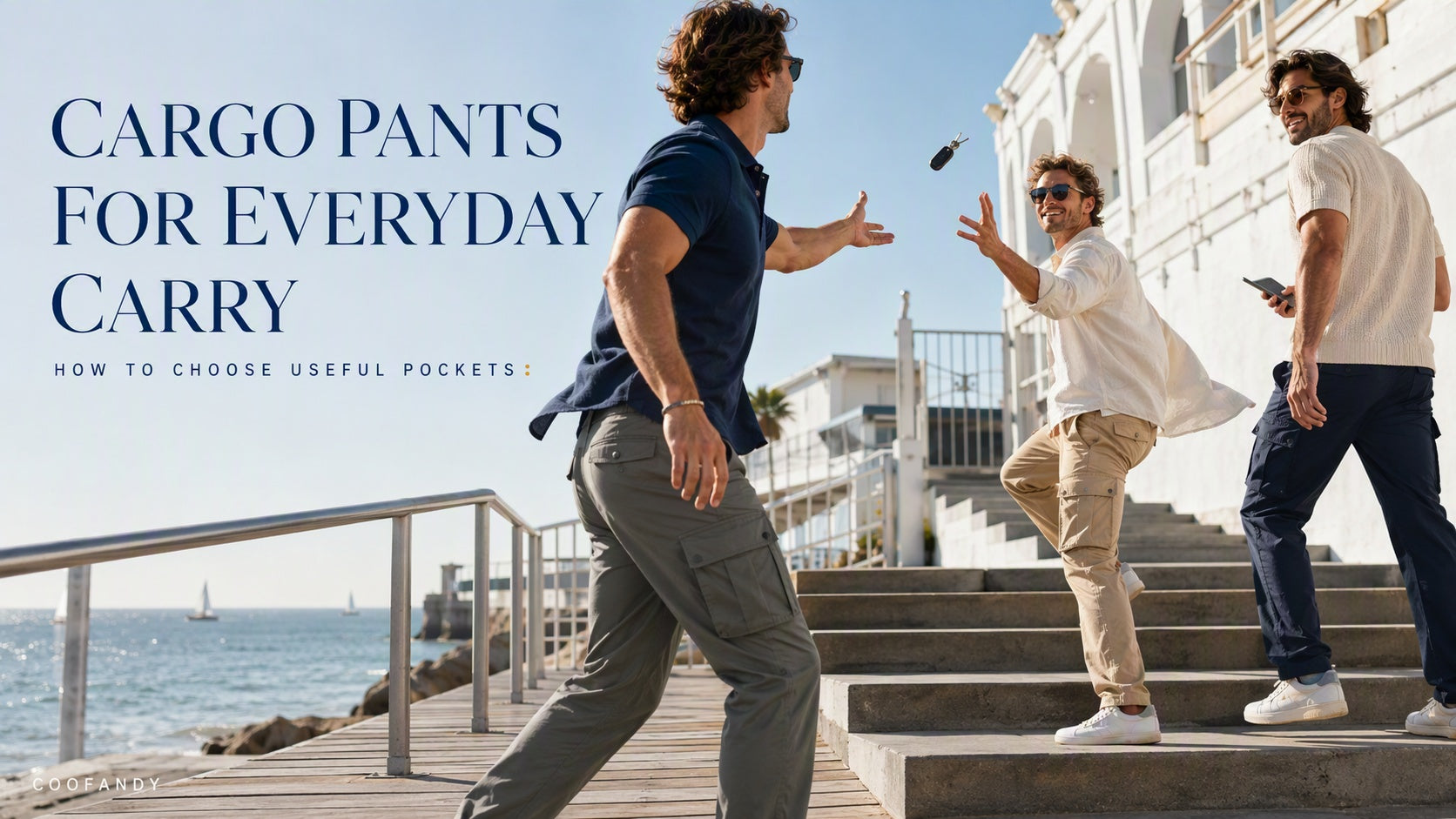
Quick answer: Most people do not need cargo pants just because a phone feels big. If your usual carry is a phone, wallet, and keys, regular pockets may already do the job. Cargo starts to make sense when one item keeps crowding the rest, poking you when you sit, or getting mixed up with keys. A pouch or small bag is the better call when the load gets bulky or changes through the day. Before you buy anything, picture four moments: reaching for it, closing the pocket, walking with it, and sitting down with it.
Start With What You Actually Carry
Before you look at another pair of pants, empty your pockets onto a table. The phone, slim wallet, keys, earbuds, transit card, sunglasses case, and medication you carry can feel harmless one by one. Put them together and they tell a clearer story.
- Size: Is the item flat, bulky, long, or awkwardly shaped?
- Weight: Does it disappear in a pocket, or does it pull at the waistband once you add the rest of your load?
- Access frequency: Do you reach for it many times a day, once at the door, or only when you are away from home?
- Sensitivity: Would a scratch, accidental loss, or visible outline create a real problem?
Next, separate what has to be on you from what is simply nice to have nearby. Phone, wallet, keys, and a transit pass often need a quick grab. A charger, water bottle, notebook, larger headphones, and spare layer usually make more sense in a tote, backpack, or pouch. A pocket does not become the right home for an item just because the item can be forced into it.
You can make the first call before comparing a single product:
- Stay with standard pockets if your usual load is light, flat, and does not bother you once you sit down.
- Try cargo pants if one item needs to live away from the rest and a side-pocket spot still feels natural when you walk and sit.
- Carry a pouch or small bag if the load is bulky, heavy, fragile, or different from one part of the day to the next.
That is the whole point. A useful pocket should disappear from your mind once you leave the house. If your current load already does that, cargo pants are a preference, not a fix you need.

Pocket Position Matters More Than Pocket Count
Two pairs of pants can both promise extra pockets and feel nothing alike once you put your things in them. The difference is not the number on the product page. It is where the item lands on your body, whether it stays put while you move, and whether you notice it the second you sit down.
Quick reach for a phone or card. Make sure the opening and seated angle still work for your phone.
Keeps a slim item quiet while standing. Check pressure and access before relying on it when seated.
Creates separation from front-pocket traffic. Check for swing, outline, and reach while walking.
Front pockets do the everyday work. They are where your hand goes for a phone, keys, or card without thinking. They also get crowded fast. A few hard objects can knock together, show through the fabric, or press into the hip crease when you sit. A front pocket earns a frequently used item only when the opening, depth, and seated angle work with that item.
Rear pockets can look tidy while you are standing. The mood changes when you sit on a thick wallet, hard case, or key ring. Reaching behind you in a car, restaurant booth, or office chair is not much fun either. Use a rear pocket on purpose, not out of habit. Sitting comfort counts as part of the pocket's capacity.
Side thigh pockets are the real cargo question. They can keep a phone or another essential away from the traffic in your front pockets. They also put that weight farther from the middle of your body. If the pocket hangs low or the item is too heavy, you may feel it swing with every step or knock against a chair. Forget "How many cargo pockets?" Ask instead: "Which item can live here without getting in my way?"

Match Closure to the Risk
A closure is there to match the way you live with the item. It cannot rescue a badly placed pocket. Think about how often you reach for the item, whether you will be sitting, and how annoying it would be to discover it has shifted.
Open pockets suit items you reach for often, such as a transit card, phone, or handkerchief. Their limitation is simple: an item is easier to dislodge when the opening is shallow, the item is tall, or you sit and stand repeatedly. Reserve them for quick-access items only after a movement check.
Zippers slow the moment down by one small step. That is often fine for keys or earbuds you do not grab every few minutes. The question is simple: can you open and close the pocket comfortably, and does the item still sit flat when it is closed?
Snaps or buttons suit people who want to see and feel that a pocket is closed without dealing with a zipper. Hook-and-loop closures can be quick, but the sound, bulk, and wear over time depend on the garment. A flap alone does not tell you what is underneath it. Look at the actual product page and close images before deciding.
For valuables or an unfamiliar travel day, a closure is one piece of the picture, not a promise. Keep the item where you can feel it, do not overfill the pocket, and move up to a pouch or bag when pants start asking too much of them.
Cargo Pants vs. Work Pants, Travel Pants, and a Pouch
Use this table as a decision check, not a category ranking. The question is which option creates the least friction in your routine while still carrying the things that must stay with you.
| Option | Capacity | Appearance | Load stability | Weather and office fit |
|---|---|---|---|---|
| Cargo pants | For a few separate essentials, not a full daily kit. | Visible side pockets become part of the outfit. | Worth choosing only when the loaded side pocket stays still through the walk-and-sit test. | Check the exact fabric and silhouette; best suited to settings where a casual pocketed trouser makes sense. |
| Work pants | Choose only when a job or task creates a specific storage requirement. | Usually signals a more utilitarian use case. | Judge the exact garment; one work-pant design does not establish another's construction. | Let workplace rules lead. Do not buy task-oriented pants merely to solve a phone-and-wallet problem. |
| Travel pants | A lower-profile choice when the goal is to keep only a few items on your body. | Often the least conspicuous pants-based option. | Use the seated test for the transport you actually take; a flight-seat need differs from a short drive. | Verify the exact fabric, care, and stated features rather than assuming a travel label answers them. |
| Pouch or small bag | The clearest choice for a mixed, bulky, or changing load. | Moves the visible bulk off the pants and into a separate accessory. | Keeps weight out of the waistband; evaluate the strap or carry method separately. | Easy to set aside indoors and often simpler for offices or warm-weather transitions. |
Here is the simple line: cargo works when you can say, "This one item needs its own spot, and it still feels fine there when I sit." That is a good reason to try it. A bottle, tablet, camera, large charger, or a handful of dense objects crosses the line. Those belong in a bag.
Test the Load While Sitting and Walking
The fitting-room mirror cannot tell you whether a pocket will annoy you halfway through the day. Load the pants with safe stand-ins for the phone, wallet, keys, and earbuds you normally carry. Then move around. Empty pants on a hanger are easy to like.
- Load it for real. Put each stand-in where you would naturally keep it on an ordinary day.
- Walk a little. Notice whether a side-pocket item swings, taps your leg, or starts pulling the pants out of place.
- Take a seat. Use a chair, bench, or car-seat-like position. Pay attention to your hip, back pocket, and thigh.
- Climb a few steps. A pocket that gapes, shifts, or changes your stride is giving you useful information.
- Reach for each item. You should not have to hunt around, fight a closure, or stand up first.
Trust what your body tells you. If an item swings, presses into you, drags the waistband, or turns into an awkward reach, that pocket is wrong for that item. Move it, carry less, or bring a bag. This is a simple fit check, not a performance or durability test.

Buying Checklist for Useful Pockets
By now, you should know whether cargo is even the right category. Only then is it worth opening a product page. The page should confirm the layout you need; it should not talk you into a vague idea of "extra storage."
- Position: Which exact item goes in each pocket, and can you reach it seated as well as standing?
- Closure: Is the pocket open, zipped, snapped, buttoned, or another verified construction? Does that match the item and setting?
- Bag and seam details: Read the product description and inspect close images. Pocket-bag fabric and seam construction are not implied by the word "cargo."
- Capacity: Look for actual dimensions or an explicit product statement. If neither is available, treat capacity as not verified and test after delivery before wear.
- Waist stability: Consider whether your planned load makes the waistband shift, sag, or feel restrictive once you walk and sit.
- Context: Check fabric, fit, and care on the exact pair for the weather and setting where you expect to wear it.
The official product page for COOFANDY Cargo Loose Fit 100% Cotton Pants listed a loose fit, 100% cotton, two side pockets, and one flap pocket. It did not provide verified pocket dimensions, a stated flap closure mechanism, or a load rating in the material reviewed for this article. Use that kind of product-specific detail as the standard: match your item map to what the page actually says, rather than assuming every cargo design carries the same way.
FAQ
Where should I put my phone in cargo pants?
Put your phone where you can grab it without twisting, digging, or feeling it jab you when you sit. A front pocket may be the easy answer if you use it all day. A side thigh pocket can keep it away from your keys if that pocket holds it steady. The right spot depends on the phone, the opening, and how the pants feel once you move around.
Will cargo pants look bulky?
They can, especially when every pocket is doing too much. A cargo pocket does not need to look stuffed to be useful. Keep only the things that truly need to stay on you, put the heaviest item in the most stable verified location, and look at the pants from the front and side before you decide. If your kit still makes the silhouette feel busy, a pouch is the cleaner answer.
Are cargo pants appropriate for commuting?
For a casual commute, they can be. The real test is the train seat, driver's seat, stairs, or walk from the parking lot--not how the pants look when you first put them on. A side pocket that behaves on a short walk may feel very different after a seated ride. If your workplace leans dressier, compare the pocket layout, fabric, and silhouette with what people actually wear there, then move the bulk into a bag.
Can cargo pants replace a bag?
Sometimes, for a light daily load. Not when you are trying to carry several heavy, fragile, or changing items.
- Light load: regular pockets or a restrained cargo layout.
- Heavier load: keep only the stable essentials in cargo and add a small bag.
- Items you really do not want to misplace: choose a verified closure and a pocket position you can notice, or use a pouch or bag that gives you more control.
Decision CTA: Choose the layout that lets you leave the house without thinking about your pockets every few minutes--then compare verified COOFANDY cargo designs. Before you publish or buy, open the exact product page one more time and confirm the pocket layout, closure, fabric, size, color, price, inventory, shipping, and return details.
Related Reading
- COOFANDY Pants Review: Fabric, Fit, and Comfort Guide
- Men's Casual Pants: How to Choose by Fabric, Fit & Occasion
- Men's Vacation Pants Guide: Choose the Right Pair for Travel
About COOFANDY
Founded in 2015, COOFANDY is a menswear brand created for modern men navigating work, weekends, celebrations, and everyday life. Its collection includes shirts, suits, pants, sweaters, and tees designed to help men build versatile, confident looks for different moments and personal styles. Guided by the belief that clothing can reflect confidence and character, COOFANDY focuses on making approachable menswear part of every stage of life.

Leave a comment