









Types of Pants: How to Choose by Use, Fit, and Fabric
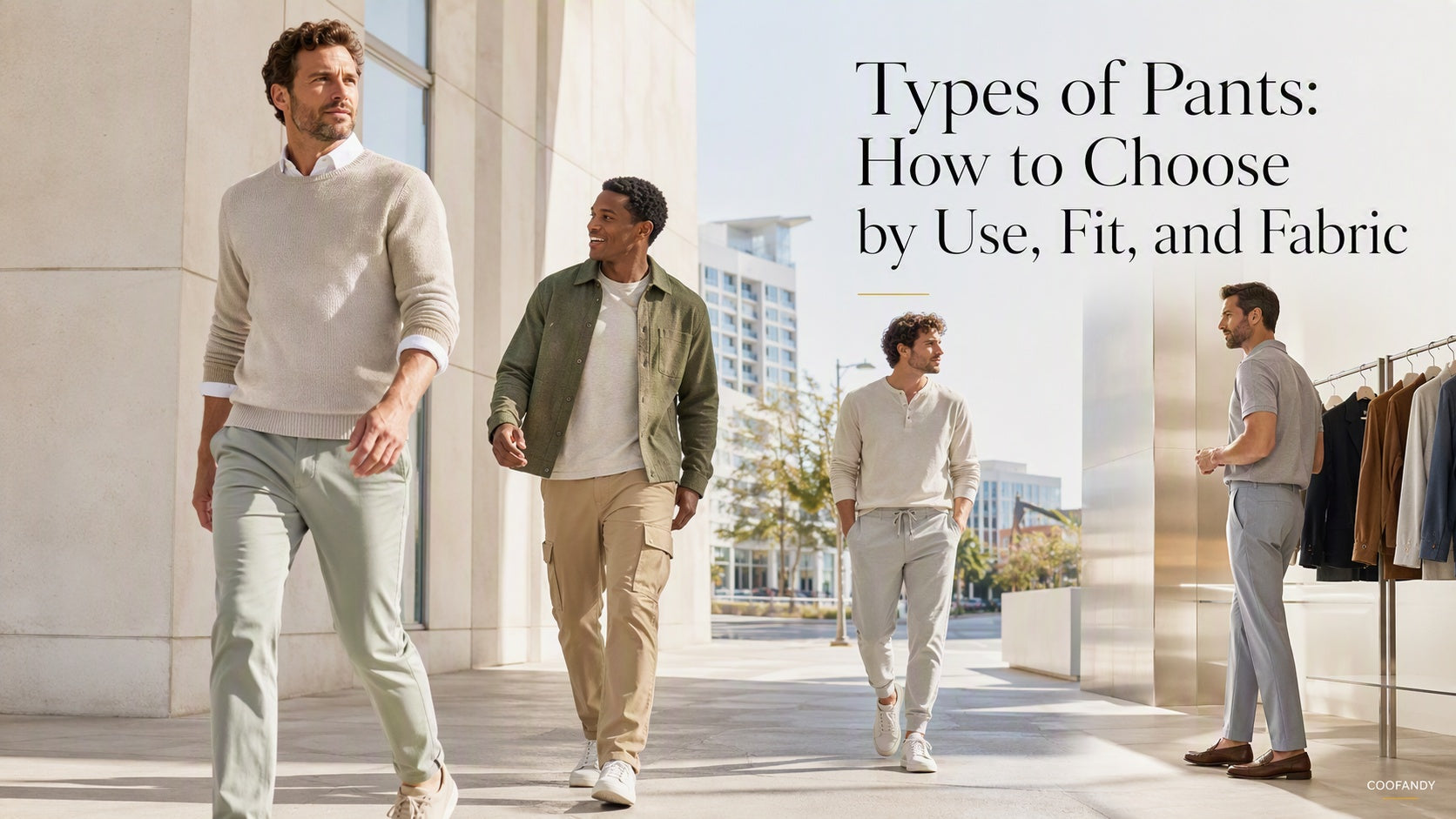
The short version: Most pants names tell you only part of the story. Start with three everyday decisions: where you’ll wear them, how you want them to fit, and which fabric suits the weather and the care routine you’ll actually follow. Fit needs two passes, so this guide uses four checks: use; room and leg shape; rise and length; fabric and care. One pair can carry several labels at once. Cargo pants, for example, may also be tapered, mid-rise, and made from cotton twill.
Two chinos can look and feel completely different. The word chino doesn’t promise a certain leg width. Wide-leg tells you the outline, but not whether the pants make sense for an office, a weekend, or a rainy commute. Product names are clues. You still need to look at the rest of the pair.
Decode the Label Before You Compare the Pants
A product title can look like a pile of unrelated words, but each word usually has a job. Chinos, cargo pants, dress trousers, work pants, and joggers are broad product families. The family name may point to the original use, pocket layout, waistband or hem, or a familiar construction. It still doesn’t tell you the whole shape of the pants.
Fit words describe something else. Slim and relaxed mostly tell you how close or roomy the pants are. Straight, tapered, and wide describe the line or volume of the leg. Low-, mid-, and high-rise refer to waistband position and crotch depth. Fabric terms are mixed as well: linen and nylon identify fibers, twill and denim describe construction, and corduroy and fleece name recognizable structures or surfaces.
So if you see “tapered cargo pants,” the words aren’t contradicting each other. Cargo points to the utility-pocket family; tapered means the leg narrows toward the ankle. Joggers can have cargo pockets. Dress trousers can be straight or tapered. Linen is a material, so linen pants may be casual drawstring pants or more structured trousers.
When a product name starts getting crowded, translate it with four questions:
- Use: What kind of pants are these, and where will I actually wear them?
- Room and leg shape: How much space is there through the seat and thigh? Below the knee, does the leg stay straight, widen, or taper?
- Rise and length: Where does the waistband sit, and where does the hem land with my shoes?
- Fabric and care: What can I tell from the weight and texture, and what does the label require?
This is a practical way to shop, not an official apparel standard. Brands don’t use fit words in exactly the same way, and plenty of pants sit between familiar categories. Let the name narrow the field, then check the photos, measurements, fabric composition, and care instructions.
Start With Where You’ll Wear Them
Before you get pulled into fabric names and fit labels, picture a normal day in the pants. Where are you going, what will you be doing, and how dressed-up do you need to look? Pick the closest row below. The middle column mixes familiar pant types with a few fabric-based options because it is a shortlist, not a new set of categories.

| Where you’ll wear them | Start by comparing | The question that separates them |
|---|---|---|
|
Everyday wear Errands, meals, and casual plans |
Jeans, chinos, five-pocket pants, or simple drawstring pants | Does the same pair also need to work in a casual office? |
|
Office or dressier events Offices with a dress code, weddings, and graduations |
Dress trousers or other tailored-looking pants | What does the dress code require, and which shoes will you wear? |
|
Hands-on tasks or extra storage When pocket space or practical details matter |
Cargo pants, carpenter pants, or work-style trousers | What will you carry, and what happens to the leg when the pockets are loaded? |
|
Exercise, relaxed travel, or home When easy movement and casual wear take priority |
Joggers, sweatpants, or track pants | Which movements need to feel easy, and do the pockets hold their contents securely? |
|
Challenging weather Hot, cold, wet, or windy conditions |
Linen or linen-blend pants, lined pants, or rain-oriented overpants | Which condition matters most, and is the exact pair built and labeled for it? |
What If One Pair Has to Do Two Jobs?
The table is easy when one setting clearly matters most. Real life is usually less tidy. You may want one pair for errands and the office, or for a flight and dinner afterward. Write down both jobs. Whichever one has the stricter requirement gets the first say; the other helps you choose between the pairs that survive that first cut.
Everyday wear plus a casual office
Let the office dress code go first. Prominent utility pockets, a visible drawstring, elastic cuffs, distressing, or a fleece-like surface all push the look in a more casual direction. That may be fine in your workplace, but it is worth noticing before you buy. Among the pairs that look right at work, choose the one that also feels easy enough for errands and downtime. A clean chino or five-pocket design often crosses over more easily; a softer, pocket-heavy pair may be better once you are off the clock.
Travel plus dinner or a meeting
For travel, sit down before you decide. The waistband should not dig in, the rise should not pull, and your thighs need enough room for a long stretch in a seat. Put something in the pockets too. Does it stay put? Then think about dinner or the meeting: can the drawcord be hidden, do the cuffs look too relaxed, and does the hem work with the shoes you packed? If the pants are great on the plane but wrong for the room you are walking into later, pack a second pair.
Extra storage without professional workwear
Do not count pockets. Load them. Put your phone, wallet, keys, or whatever you really carry into the pockets you would use, then walk, sit, and climb a step. A big pocket may hold more, but it can sag, swing, press against your thigh, or make the leg look bulky. A flap or zipper may keep things in place, though it can also slow you down when you reach for them. If your job calls for protection, visibility, abrasion resistance, or another occupational feature, check that requirement separately. Casual cargo and work-style pants are not safety equipment.
Weather plus a dress code
“Weather-friendly” is too vague to shop with. A ten-minute walk in heat is different from hours in steady rain. Moving all day between cold streets and heated rooms is another problem again. Look at weight, lining, weave or knit, opacity, and any weather claim made for the exact product. Long or harsh exposure puts weather function first. If you’re outside briefly and indoors for hours, the dress code may matter more. Either way, the pair has to handle both parts of the day.
At this point, set aside anything that fails the harder job. Now you can compare the remaining pairs by fit without wasting time on pants that were never right for the setting.
Room and Leg Shape Are Two Different Things
Fit gets much easier to read once you separate two ideas: how much room you have and where the leg goes. Ease is the space between your body and the pants, especially at the seat and thigh. Slim and relaxed mostly speak to that room. Straight and tapered tell you what happens from the knee to the hem. Wide signals extra volume through much of the leg.
A label such as relaxed tapered now makes more sense: there is room at the thigh, but the leg narrows near the ankle. Slim straight means the upper leg sits closer while the width changes less below the knee. Those words are only directions, though. Brand cuts vary, so confirm the shape in photos, measurements, and a few basic movements.
| What the label mainly describes | What that looks like | What to do in the fitting room | What you may give up |
|---|---|---|---|
|
Slim Overall closeness and ease |
Closer through much of the seat, thigh, and leg; it does not have to mean skin-tight. | Sit down and climb a stair. Watch for strong horizontal creases or pocket openings that pull apart. | Less room for movement, layers, or loaded pockets. |
|
Relaxed Seat-and-thigh ease |
Adds ease, often through the seat and thigh; the lower leg may still be straight or tapered. | Walk and sit. Check that you gain useful room without unwanted bunching around the seat, knee, or hem. | More room can feel easier while making the outline fuller. |
|
Straight Knee-to-hem shape |
Changes little in width from the knee to the hem, although every brand cuts it differently. | Check whether the hem falls cleanly over your intended shoes without catching. | More width remains at the ankle than with a taper, so shoe and hem length matter. |
|
Tapered Knee-to-hem shape |
Narrows toward the ankle; the seat and thigh can still be slim, regular, or relaxed. | Bend your knee, check the calf, and make sure the hem works with the shoes you plan to wear. | A narrow opening keeps fabric away from the ankle but may feel tight at the calf or limit footwear. |
|
Wide Overall leg volume |
Keeps noticeable width through much of the leg rather than only below the knee. | Take a full stride and turn. Make sure the hems do not drag or brush together enough to interrupt your stride. | Extra length can drag or bunch over shoes, so hem position matters. |
Read a combined fit name from the top down. Start at the waistband, seat, and thigh: is there enough room? Then look below the knee: does the leg stay straight, open up, or narrow? This tells you where the problem really is. A tapered pair may feel tight because the thigh is too close, not because of the ankle opening. A wide leg may add fabric below the knee when all you wanted was more room at the seat.
Skip the rigid “body type” rules. Pick an outline you like, then see whether you can sit, bend, and walk without the seat or thighs pulling. When the waistband fits but the thigh does not, a roomier cut often makes more sense than sizing up the entire pair. When both the waistband and seat are loose, try a smaller size. If just one area feels wrong, the cut or rise may be the real issue.
Next, Check Where the Waist and Hem Land
Rise is the distance from the crotch seam to the waistband. On your body, it affects where the waistband sits and how much depth you feel through the crotch. Low-, mid-, and high-rise are broad labels, not fixed measurements. Your proportions and where you wear the waistband change the result too.
Stand normally, then sit in a chair. The waistband should stay close to where you put it without digging in or sliding far down. The crotch seam should not pull sharply upward. Wear a higher-rise cut too low and extra fabric may collect below the seat; wear a rise that is too short for you and the fly may pull when you sit.
Sizing up doesn’t fix every rise problem. If the waistband fits but the crotch or upper thigh feels cramped, try another rise or cut before making the whole pair larger. If the waist, seat, and thigh all feel tight, the next size is a reasonable comparison. Check the product measurements either way; the same labeled size can fit differently in another cut.
Inseam is the inside-leg measurement from the crotch seam to the hem. It is useful for comparing lengths, but it can’t predict the finished look on its own. Rise, waistband position, leg width, shoes, and hem construction all change where the pants end. The inseam that works for straight trousers may look quite different on wide-leg pants or cuffed joggers.
Break is the fold you see when an open hem rests on the shoe. No break leaves little or no fold; a slight or full break adds more. Stacking is several folds gathering above the shoe, usually for a casual look. Neither is automatically right. It depends on the silhouette you want.
Bring the shoes you plan to wear. Look at the hem from the front, side, and back. Is it too high, resting cleanly on the shoe, folding on purpose, or dragging under the heel? Sit down as well; a narrow or cuffed hem can climb higher on the ankle than a wider open hem. Walk a few steps, then look again. Extra folds that seemed fine while standing may bunch once you move.
The hem itself changes the options. An open hem can sit with no break or several folds. An elastic or ribbed cuff holds the leg near the ankle, so traditional break no longer applies. A drawcord lets you change the opening, though visible hardware usually makes the pants look more casual or technical.
Fabric Can Change the Whole Pair
Two pairs with the same cut can feel like different pants once the fabric changes. A material name is useful, but it is not a complete performance report. Weight, weave or knit, fiber blend, lining, finish, and garment construction all affect how the pants hang and move. The exact composition and care label matter more than the headline fabric word.
The table below separates what a fabric term actually tells you from what you still need to check on the garment. That second part matters: “nylon” alone doesn’t promise rain protection, and “twill” doesn’t tell you how heavy or stiff the pants will feel.

| Fabric term | What the word actually tells you | What still needs checking | What you may notice in wear |
|---|---|---|---|
| Twill | A woven structure with visible or subtle diagonal lines. | Look at the weight, stiffness, blend, stretch content, and finish. The word “twill” is not enough. | A crisp twill can look neat but may feel more structured; a softer version can look more casual. |
| Denim | A warp-faced twill construction commonly associated with jeans. | Check the fabric weight, stretch, wash, and care instructions for color and laundering. | Heavier or stiffer denim can need more movement room; washed or stretch versions may behave differently. |
| Linen | A flax-based material that may be woven at different weights or blended with other fibers. | Opacity, lining, weight, blend, and the exact care label. | Visible creasing is common in linen garments; decide whether that relaxed texture suits the occasion. |
| Corduroy | Raised lengthwise ridges, called wales, create visible texture. | Wale width, garment weight, color, and whether the cut feels bulky at the pocket or thigh. | The ridged texture can look visually fuller and more casual than a smooth trouser cloth. |
| Fleece | A fabric with a soft, often brushed face or interior, common in sweatpants and lounge styles. | Check the thickness, inner surface, waistband, and whether the fabric feels suitable indoors as well as outside. | Softness and warmth may come with a bulkier, more casual appearance. |
| Nylon | A synthetic fiber used in fabrics that can range from light and crisp to dense and smooth. | Check the weave, weight, blend, lining, finish, whether the fabric rustles as you move, and any verified product-level weather claim. | Nylon alone does not mean waterproof, quick-drying, or technical; appearance and care vary by fabric. |
How to Compare Two Actual Pairs
When two pairs are still in the running, put them through the same four checks:
- Temperature: Will you wear the pants outdoors, in air-conditioned rooms, or across changing conditions? Compare fabric weight, lining, and how open or dense the material feels rather than judging from one fiber name.
- Appearance: Do you want a crisp line, a soft drape, visible texture, or a deliberately casual surface? The same leg shape can look quite different in a firm woven fabric and a soft knit.
- Movement and bulk: Does the fabric fold comfortably when you sit and bend, or does it bunch behind the knee and around the waistband? Extra thickness can affect how pockets, cuffs, and layered clothing feel.
- Care: Are you willing to follow the washing, drying, ironing, or cleaning instructions shown for that garment? A fabric is not practical for your routine if its required care is something you will avoid.
In a store, pinch the fabric, hold it to the light, and let one leg hang. You will get a rough read on thickness, opacity, and drape, meaning how softly or stiffly it falls. Online, zoom in on the fabric and read the composition, lining details, and care instructions. If stretch, warmth, or water resistance matters to you, look for that claim on the exact product. For washing and drying, follow the sewn-in label rather than a general rule about the fiber.
Put It Together in Three Steps
By now you have looked at each part separately. Here is the quicker version to use while you shop: setting first, fit second, fabric last.
| Step | Ask | What to do next | Before you move on |
|---|---|---|---|
| 1. Primary use and setting | Where will I wear these most, and which requirement is non-negotiable: dress code, movement, storage, or weather? | Begin with tailored trousers, chinos or jeans, cargo or utility pants, joggers or sweatpants, or a weather-specific option. | Confirm the non-negotiable requirement on the exact pair. A category name does not make casual details formal, and utility styling does not make pants job-rated. |
| 2. Fit and movement | How much room do I need, what should the lower leg do, and where should the waistband and hem sit as I move? | Choose the ease and lower-leg shape separately, then test the rise, seat, thigh, knee, and hem while sitting, walking, and climbing a stair. | Do not use the fit name as a measurement. Compare the size chart and garment details for that product. |
| 3. Fabric, climate, and care | Will I wear them in hot weather, air-conditioned spaces, cold weather, or changing conditions? How much garment care am I willing to do? | Compare fabric weight and structure, then check the blend, lining, opacity, finish, and care label. | Do not assume performance from one fiber word. Verify any water, stretch, warmth, or care claim on the exact product. |
Drop a pair as soon as it fails something you genuinely need. Great fabric cannot make casual pants meet a formal dress code. A comfortable waistband doesn’t help if you can’t sit easily. And if the pair works in every other way but the care routine will annoy you, keep the shape and look for another fabric.
Your final note can be simple. For the office: “Straight leg, enough thigh room to sit, medium-weight woven fabric, care I will actually follow.” For travel: “Casual, tapered below the knee without gripping my calf, and a fabric weight that suits the forecast.” Either note is more useful than “nice pants.”
Where to Browse Next at COOFANDY
Once you can describe what you need in one sentence, open the closest collection and compare from there. A collection page saves time, but you’ll still need to check the details on each product.
- Not sure which direction fits yet? Start with the men’s pants collection.
- If useful pocket space is the priority, compare men’s cargo pants.
- For an office or dressier setting, look through the men’s business clothing collection.
- For warm-weather options, compare the construction and care details in men’s linen pants — the Casual Solid High Waist Cotton Linen Straight Pants are a breathable, everyday option to start from.
- If visible texture is the point, browse corduroy clothing.
Collections and product details can change. Check the current listing for size, color, fabric, care, price, and availability before you buy.
FAQ
What is the difference between “pants” and “trousers”?
In US English, pants is the everyday umbrella term. Trousers is also understood, but it often sounds more formal or tailored. Other varieties of English use the words differently, so check the store and audience when shopping internationally.
Which pants suit my body type?
No cut is automatically right for a body type. Start with a silhouette you like and see what happens when you move. The waistband should stay put, the rise should feel comfortable, and the seat and thigh shouldn’t pull. Proportion is a preference, not a rule you have to obey.
How can I tell whether I need another size or another cut?
Pay attention to where the problem starts. If the waistband, seat, and thigh are all tight, compare another size. If the waistband is fine but the thigh pulls, the rise feels short, or the calf catches, try another cut first. You may fix that one area without making the rest of the pants baggy. A gaping waist with a good seat-and-thigh fit can also point to a different cut or waistband shape. These are clues rather than hard rules, so check the measurements and sit down before deciding.
How long should pants be?
The useful length is the one that creates the hem you want without dragging or catching underfoot. Open-hem trousers can sit with no break, a slight break, or a fuller fold. Wide-leg pants may skim the shoe; cuffed joggers usually stop near the ankle. Try the length with the shoes you will wear and check it both standing and seated. If the listing gives inseam measurements, use them instead of trusting “short,” “regular,” or “long” on its own.
What if a pair belongs to more than one category?
Read the name one word at a time. In “wide-leg corduroy trousers,” trousers names the family, wide-leg describes the silhouette, and corduroy identifies the fabric structure. The labels overlap because they answer different questions. If the title is still vague, trust the photos, measurements, composition, and care label.
What should I do in the fitting room?
Before you decide, do these six ordinary things. They catch more than standing still in front of a mirror.
- Stand normally. See where the waistband lands, how the front hangs, whether the pockets pull open, and whether the side seams look reasonably straight.
- Take a seat. Notice any pressure at the waist, rise, seat, or thigh. Check whether the pockets gape.
- Walk and climb a stair. Watch for pulling at the knee or thigh, and notice whether a narrow hem catches on your calf.
- Put on the right shoes. Look at the break, stacking, cuff position, and heel clearance from every side.
- Load the pockets. A phone, wallet, or keys can change the drape and add sag or bounce. A casual pocket may not be secure or built for heavy equipment.
- Read the label. Confirm the fiber content, care instructions, and any product-specific claim that matters to your choice.
Ready to narrow it down? Identify the occasion first. Then choose the silhouette and rise, and finish with a fabric that suits your weather and the care you are willing to do.
Related Reading
- Men's Casual Pants: How to Choose by Fabric, Fit & Occasion
- COOFANDY Pants Review: Fabric, Fit, and Comfort Guide
- Intern Pants Dress Code Decoder: Jeans, Chinos, Linen, or Drawstring Trousers?
About COOFANDY
Founded in 2015, COOFANDY is a menswear brand created for modern men navigating work, weekends, celebrations, and everyday life. Its collection includes shirts, suits, pants, sweaters, and tees designed to help men build versatile, confident looks for different moments and personal styles. Guided by the belief that clothing can reflect confidence and character, COOFANDY focuses on making approachable menswear part of every stage of life.

Lascia un commento