










Smart Casual Blazer or Suit Jacket Which Works Better

You have a suit hanging in the closet and an invitation that says smart casual. Do you need another jacket, or can the one you already own do the job?
For a look built around contrasting trousers, we'd start with the light-beige textured patch-pocket blazer in COOFANDY Signature. For an occasion that requires a suit, keep your suit jacket with its matching trousers. Between those situations, try your existing jacket as part of a complete outfit before deciding to buy anything. The useful comparison is not which label sounds smarter; it is which jacket works with the clothes and occasion you actually have.
Start with What the Invitation Requires
Read the invitation for a specific requirement before interpreting the phrase smart casual. A client may expect a suit even at a restaurant where other guests dress informally. A friend's birthday dinner may leave much more room for separates. Ask the organizer what they expect when those signals disagree.
A useful question is, "Would a blazer with contrasting trousers be appropriate, or are you expecting a matching suit?" That gets you closer to an outfit decision than asking whether the event is "dressy." If the answer is a suit, this is not the moment to make a separate jacket imitate one.
When separates are welcome, choose the base outfit before selecting the jacket. Lay out the top, trousers and shoes together. A pale shirt, dark trousers and plain leather shoes give you one starting point; a plain T-shirt, trousers and clean sneakers give you another, but only for a setting that welcomes that combination.
Do not change all four pieces to rescue the wrong premise. If T-shirts are not appropriate, replace the T-shirt first. If a matching suit is required, return to the suit. A jacket choice cannot settle a dress-code question that is still unanswered.
Identify the Jacket, Not Just Its Name
A suit jacket belongs to a suit with trousers made from the same fabric and pattern. That matching relationship is the starting distinction here. It does not tell you, by itself, whether the jacket you own will look good with a different pair of trousers.
Take your suit jacket off its hanger and put it beside the trousers you want to wear. Look at the combination in daylight. Can you clearly see that these are two deliberately different pieces, or do they look like an unsuccessful attempt at a matching set? We would avoid almost-matching colors when the fabrics visibly disagree.
Then add the top and shoes. A jacket that looks plausible beside folded trousers may still feel out of place once a casual top is underneath it. Judge the whole arrangement rather than deciding that every navy jacket, metal button or textured surface belongs to a fixed category.
Keep the comparison on one axis: matching suit or separate outfit. Lining, shoulder shape, fabric weight and how a jacket sits on you are additional considerations, not automatic definitions of the word blazer. You do not need to prove that one category is always softer, lighter or less formal to choose between the two jackets in front of you.
If the suit jacket works with a distinct trouser color and the occasion accepts separates, reusing it is a reasonable option. If it only feels convincing with its own trousers, there is nothing to fix: wear the suit when you need the suit.

Build a Separate Look Around the Signature Blazer
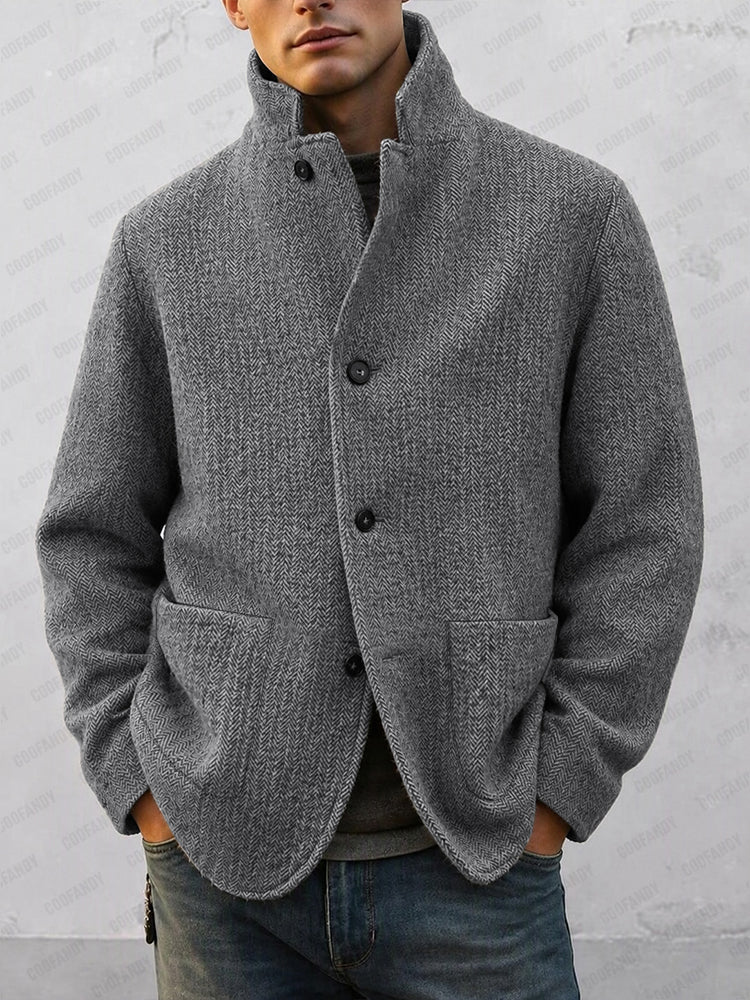
Our example is the light-beige Classic Textured Sheep Wool Blend Blazer, AMV007698: notch lapels, a two-button front, lower patch pockets, double back vents and a fine vertical surface texture. Its composition is 56% polyester and 44% sheep wool. Those details identify the jacket; they are not a reason to assume how warm an entire outfit will feel.
Start with a pale-blue collared shirt, charcoal trousers and dark-brown leather shoes. We would tuck the shirt, keep the trouser front clear of bulky pocket contents and leave other accessories restrained. The darker trousers establish an obvious separate from the light-beige jacket, while the blue shirt gives you another color without introducing a competing pattern.
The gold-colored front button is already a visible accent. Try the outfit without a large belt buckle or conspicuous jewelry before adding either. The patch pockets and textured surface also give you details to work around; you do not need a patterned shirt to make this combination interesting.
For a more relaxed dinner where T-shirts are welcome, try a plain white crew-neck T-shirt, dark-olive trousers and simple brown loafers with the same blazer. Choose a tee length that leaves the trouser line readable rather than forming a long band below the jacket. This changes the base outfit, not the identity of the Signature jacket.
Compare those two looks with shoes on. If the T-shirt version feels too relaxed for your plans, keep the blazer and return to the collared shirt. If the pale-blue shirt and charcoal trousers feel more serious than the event needs, the tee version gives you a different route without requiring another jacket.
Explore the COOFANDY Signature collection, keeping this light-beige blazer as the reference for these outfits. Do not assume every Signature jacket has the same pockets, fastening or fabric.

Compare Your Suit Jacket Without Buying Another
Now give your existing suit jacket the same opportunity. Start with the collared-shirt outfit, substituting trousers that clearly contrast with your jacket. If your suit is charcoal, for example, try mid-blue trousers rather than another charcoal pair that nearly matches. These are wardrobe color suggestions, not a requirement to buy specific supporting pieces.
Make one change at a time. First compare the jacket and trousers. Then check the shirt collar and how much shirt appears at the front. Finally add the shoes. This makes it easier to notice whether the awkward part is the jacket itself or simply a top that does not belong in that outfit.
Stand naturally, sit down and reach forward as you would across a dinner table. Watch for a shirt collar that disappears under a lapel, an underlayer that bunches at the waist or a jacket front you keep pulling into place. Those observations help you choose what to adjust; they are not proof that the whole garment category is wrong for you.
For example, if the shirt bunches but the jacket still sits as you want, try a different shirt before ruling out the jacket. If contrasting trousers make the jacket look disconnected from everything underneath, put its matching trousers back on and compare. A complete suit may be the stronger outfit even when separates are technically permitted.
Photograph the suit-jacket version and the Signature-inspired combination from the same distance. Look at the outfit as someone greeting you would, not as a close-up inspection of buttons. Ask which one seems deliberate, which one meets the invitation and which one you would be happy to keep wearing after taking the jacket off.
Do not force a purchase decision from a single mismatched outfit. Equally, do not buy several new supporting pieces merely to make an existing jacket serve a role you rarely need. The comparison should reveal an actual wardrobe gap, not create one.

Keep the Outfit That Answers the Occasion
There are three useful outcomes. Keep your existing suit jacket as a separate if the complete outfit works and the occasion allows it. Wear the matching suit if that answers the invitation or simply looks more coherent. Consider the Signature blazer when you want the specific light-beige, textured, patch-pocket look and have a recurring use for it with contrasting trousers.
Before choosing that third route, name two real occasions and assemble two bases from clothes you already own. The pale-blue shirt and charcoal trousers might cover a jacket-welcome dinner; the white tee and olive trousers might cover a relaxed evening. If both plans are hypothetical, you may not need another jacket yet.
Find more about the series on the COOFANDY Signature page. For your own wardrobe, keep the decision concrete: the required ensemble, the exact jacket and the complete outfit. A blazer is useful when it solves that combination, not because a suit jacket must always be the wrong choice.
FAQ
Can I wear a suit jacket with different trousers?
Yes, when the occasion accepts separates and the complete outfit looks deliberate. Try clearly contrasting trousers, then check the top and shoes together. If the jacket only works convincingly with its matching trousers, keep it as a suit rather than forcing a separate outfit.
Is a blazer always less formal than a suit jacket?
Do not use the label alone to decide. A suit jacket belongs with matching suit trousers, but the suitability of a separate outfit also depends on the particular jacket, supporting clothes and dress code. If the invitation requires a suit, a blazer with contrasting trousers is not the same ensemble.
Do I need to buy a blazer if I already own a suit?
Not necessarily. Test your suit jacket with contrasting trousers and a complete base outfit first. Consider a separate blazer when its specific look solves a recurring need that your existing suit does not, rather than buying one just to satisfy a category label.



Dejar un comentario